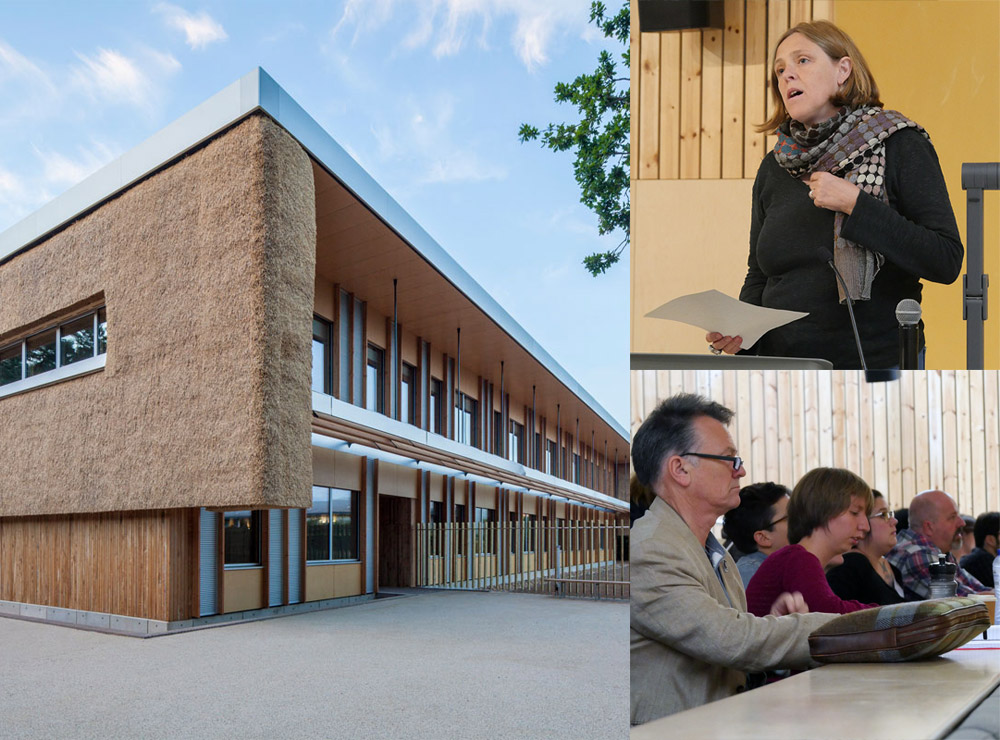
The annual International Literary Translation & Creative Writing Summer School, delivered by the British Centre for Literary Translation (BCLT) and WCN, took place on 23 – 29 July 2017. The Summer School brings together writers and translators for an intensive, one-week, residential programme of hands-on translation and creative writing practice. Below, WCN Programme Assistant Flo Reynolds reflects on her experience at the Multilingual Poetry Workshop led by Fiona Sampson.
The covetable opportunity to sit in on the Multilingual Poetry Workshop at this year’s BCLT Summer School, led by Fiona Sampson, was too good to miss. I witnessed the crucial stage of moving from a literal to a literary translation, and the enthusiastic early stages of devising a pitch to publishers. Observing the group translate Amir Or’s “Epitaph” from the Hebrew was a particular joy, and one that confirmed the peculiar gift of Summer School: the gift of pause, of sifting something precious – ever so carefully – until it is revealed glittering, altered, exquisite.
I was interested to see how such a diverse group of translators – working from nine languages as various as Kazakh, Romanian and Icelandic into English, and hailing from all over the world – would approach a single poem. Would this diversity of language and experience manifest overtly in the translations, or would some essential kernel of the poem surface? I was soon captivated by more pressing questions, however: how to convey a sense of gravity without slipping into ‘poetry voice’? What are the different implications of ‘traveller’, ‘passer-by’, ‘young man of the road’? How does the placement of a single comma change a linear progression into concurrency? All these conundrums and more were raised by the first quatrain alone.
The BCLT Summer School offered a rare gem, even to a non-specialist observer like me
Following on from a plenary on pitching to publishers from The Starling Bureau, which covered both the essentials of pitching and innovative new models, the workshop groups were tasked with crafting their own pitch to a panel of real, live, busy publishers. This raised a plethora of possibilities for the Multilingual Poetry group. What about a fantasy anthology encompassing poems from many different languages? Ok, how about we go for 100 poems, translate 10 each… What would be the timeline on this? Or why not a book of short essays on translation from emerging translators? How would we pitch this? Approaching the project on a macro level and integrating industry clearly excited the group, and no wonder: publication represents a tangible chance to champion a beloved work to a global readership. The genuine willingness on the part of translators to engage with the publishing world was striking.
The BCLT Summer School offered a rare gem, even to a non-specialist observer like me: space and time devoted to literary translation in all its minute negotiations of lexis and syntax, and the chance to accompany a work on its journey from literal rendering to publisher’s catalogue. This intensity of attention felt somehow luxurious. I returned to the office galvanised.
About the Summer School
The Summer School, delivered by the British Centre for Literary Translation in partnership with Writers’ Centre Norwich, brings together writers and translators for an intensive, one-week, residential programme of hands-on translation and creative writing practice.
For language-specific workshops, groups work on a collaborative translation with the author in residence and workshop leader. For translators working from any other languages there are two multilingual workshops, one for poetry and one for prose. These are designed for translators working from any language into English.
All workshops are designed to encourage collaboration and peer learning in a small group setting.
During the week, the workshops will be complemented by plenary sessions, which will have a particular focus on the publishing industry, and how publishers and translators work together.
You may also like...
Apply now! Visible Communities residencies 2024
We invite UK-based Black, Asian and Ethnically Diverse literary translators working from any language into English to apply for one of our Visible Communities residencies.

26th April 2024
Watch ‘Making the Unfamiliar Familiar’
How does a translator approach texts from the East written in a classical language which is culturally unfamiliar in the West?
12th April 2024
Watch Meet the World: Translating Nature and Sacrifice
Join translators Sim Wai-chew, Daniel Eltringham and Nicky Harman as they explore the short stories and poetry of two writers heavily involved in guerrilla warfare.
12th April 2024