Meet the future of literary translation
Founded by Daniel Hahn in 2010, NCW’s translation mentoring programme aims to develop successive new cohorts of literary translators into English, particularly for languages whose literature is currently under-represented in English translation.
The Emerging Translator Mentorships scheme matches experienced translators with emerging translators for a six-month period during which they work together on practical translation projects, developing their craft through working on a chosen text or texts. The mentor acts as an adviser to the mentee on aspects of life as a professional translator, such as time management, meeting deadlines, managing finances and understanding contracts, and as an advocate for their mentee with publishers in search of literary translators. The mentor will be a professional literary translator but may not translate from the language supported in the mentorship.
Meet our translators
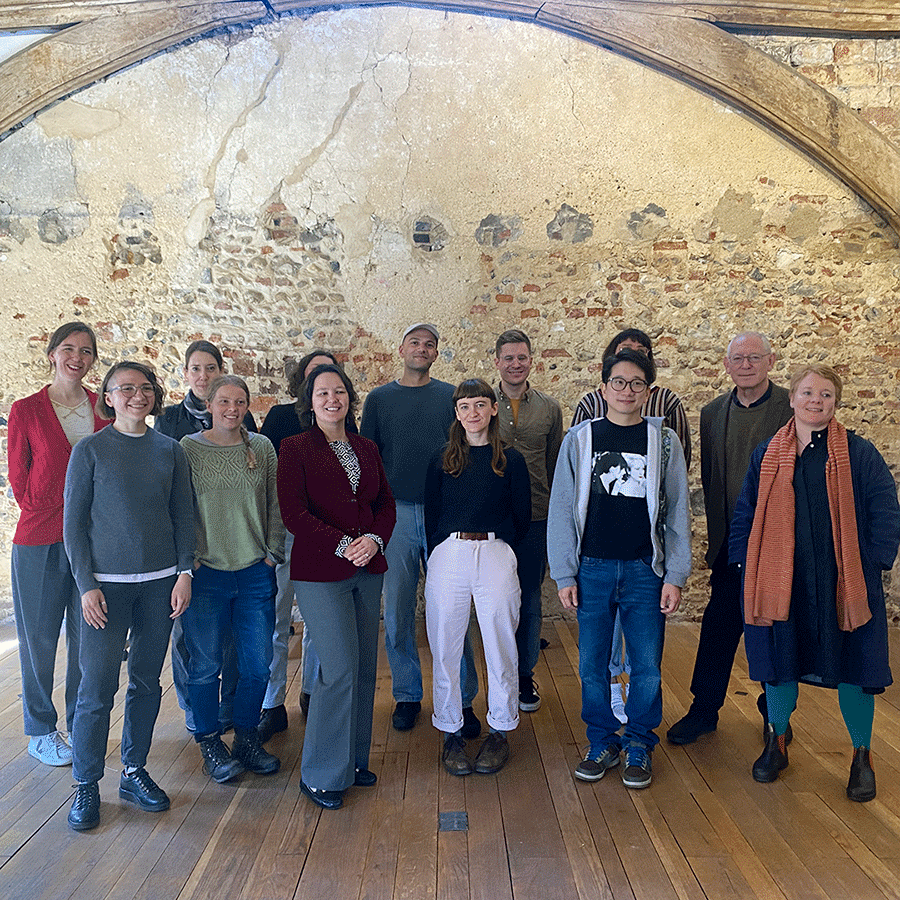
Meet the nine mentees selected for the Emerging Translator Mentorships Programme 2024 and discover what we have in store for them in the coming year.
Find out more
Championing new literary translators into English
The evidence to date suggests that participation in the scheme represents, in itself, a significant professional development for mentees, with publishers seeing the mentoring cohort as a reliable source of high-quality emerging translators.
Alumni of the programme have also gone on to feature on prize lists and been awarded major awards, such as Nichola Smalley, whose translations of Andrzej Tichý’s Wretchedness and Amanda Svensson’s A System So Magnificent It Is Blinding were longlisted for the International Booker Prize, the former also winning the 2021 Oxford-Weidenfeld Prize; Sophie Hughes, whose translations of Alia Trabucco Zerán’s The Remainder and Fernanda Melchor’s Hurricane Season were shortlisted for the 2019 and the 2020 International Booker Prize, respectively. Most recently, 2020/21 mentee Reuben Woolley was longlisted for the International Booker Prize with his first translation, Jimi Hendrix Live in Lviv by Andrey Kurkov.
Who is the Emerging Translator Mentorships programme for?
The aim of the Emerging Translator Mentorships programme is to bridge the gap between qualifying as a proficient translator – that is, by gaining proficiency in one or further language/s, either through formal education, upbringing or acquiring the necessary language skills in a social context – and becoming established as a literary translator.
We consider an emerging translator to be someone who has published no more than one full-length work of literary translation. MFA and MA students in translation can apply but priority may be given to those who do not have access to the kind of guidance already present in a translation degree programme.
Though English is the target language for translators participating in the programme, it need not be the translator’s first, native, L1 language or mother tongue, and the emerging translator need not live in the UK (unless this is a specified requirement for a particular mentorship strand).
We particularly welcome applications for all mentorships from those groups which are currently under-represented in the literary translation community, be it because of race, class, gender identity, sexual orientation, disability or any other factor posing additional hurdles on the translator to access the profession.
If you are still starting out on your literary translation journey, you might want to consider participating in our sister programme, the BCLT Summer School.
What do the selected mentees receive?
Mentees receive
- Six months of personal mentoring with a mentor in their language or field
- A stipend to cover expenses associated with the mentorship
- A tailored programme of online industry events with workshops and talks
- Exposure through a digital showcase and the publication of an anthology with sample translations
- One year’s membership of the Society of Authors/Translators Association
- Entry to London Book Fair
Meet the mentors
Find out more about the experienced translators who will be guiding you through the programme.
Discover more
How can I apply?
Applications to the Emerging Translator Mentorships programme are now closed.
Applications should be uploaded via a Google Form.
Please note, you will need a Google account (which can be created easily and linked to a non-google email address) to upload your application documents.
Your application must include the following:
- A covering letter stating why you believe you would benefit from a mentorship, and what you can bring to the mentor and mentorship
- Your CV: with a focus on your translation work and experience
- A one-page sample book proposal: this should demonstrate your understanding of the text, author and source culture, but also of the English language market for the translation and its target readership
- A sample translation of up to 2,000 words of prose or up to 100 lines poetry or dramatic text: this can be from your sample book project, or a different text or texts
- The source text that corresponds to your sample translation
- Please also complete the brief survey on equality, diversity and inclusion, which is included in the Google Forms link above. For each question, there is an option to select ‘Prefer not to say’ and all answers will be treated anonymously.
The deadline for receipt of entries was 11.59pm BST on Monday 28 August 2023.
Find out more about who can apply, how to apply and other FAQs at the link below.
Our success stories

Alison McCullough
‘One of the samples I was asked to translate during the mentorship period was from Theatre of the World by Thomas Reinertsen Berg. The English rights to the book sold to Hodder & Stoughton a short time later, who said they had enjoyed my sample and asked me whether I’d be interested in translating the whole thing.’

Somrita Urni Ganguly
‘Two years since the programme, I have four book-length translation contracts and a portfolio of shorter translated works. What had started as a curious digression from everydayness has now turned into a calling.’

Rachel Rankin
‘I have gone from knowing absolutely nothing about the world of literary translation to being more confident and more aware of everything. I have started to build up a steady stream of translation work, which would have been unthinkable just a year ago.’
For me, the Emerging Translator Mentorship did just what the name suggests: it helped me ’emerge’. No translator, be they the reincarnation of St Jerome himself, will get published ex nihilo – there’s editors who need convincing. Luckily, I got to be mentored by someone who single handedly managed to jump that hurdle herself (with ‘The Vegetarian’). The absolute trailblazer she continues to be, Deborah’s advice was nothing short of crucial as I began navigating the wondrous world of publishing.
Our Funders
Over the years, the Emerging Translator Mentorships programme has been supported by the following funders:
Arts Council England, The Danish Arts Foundation, The Harvill Secker Young Translators Prize, The Literary Translation Institute of Korea, The Polish Cultural Institute, The Royal Norwegian Embassy, NORLA, The Russian Institute for Literary Translation, The Italian Cultural Institute, Pro-Helvetia, the Yanai Initiative for Globalizing Japanese Humanities at UCLA and Waseda University, the British Council, the Sheikh Zayed Book Awards, the Swedish Arts Council, Latvian Literature, the Institut Français, Tilted Axis Press, The Saroj Lal Mentorship, the Québec Government Office in London, the British Centre for Literary Translation, the Visible Communities programme, National Arts Council Singapore, Society of Authors.

Discover more from NCW