


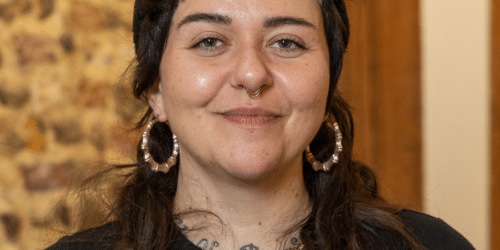
Karris McGonigle from East Norfolk Sixth Form joined the WCN (now the National Centre for Writing) team as a Young Ambassador in January 2018. Here, she interviews poet and performer Rosy Carrick about her work and advice for aspiring writers.
From what I’ve seen of your work, you seamlessly blend humour and down-to-earth qualities with topics that can be hard to tackle. How did your style develop? Was there any inspiration that you think may have played a part in this?
I think my most successful poems are the ones that felt very urgent to write at the time. It’s never my intention to write about “difficult topics”, but I write about my experiences and my sometimes mad thoughts, which inevitably includes messy or difficult stuff sometimes. Stylistically I much prefer poetry that doesn’t try to create some kind of contrived linear narrative for the sake of an easy ride for the audience. I try to write the way I think instead – i.e. with unexpected deviations and idiosyncratic language – and often grossly inappropriate details too! I started to write poetry when I was seven. As a young child I was very influenced by the unashamed sexuality of The Rocky Horror Show, and as a teenager by David Bowie and Cyndi Lauper. Now, some of my favourite poets are Keston Sutherland, Hannah Silva and Ross Sutherland.
I read that you completed a PhD on the Russian revolutionary poet Vladimir Mayakovsky. What made you want to complete a PhD on this subject? His work was clearly very political – would you relate this to any of your own poetry today?
Yes – I love Mayakovsky! He was in a crazy situation – a young, passionate, highly distinctive avant-garde hooligan of a poet who became the mouthpiece of Communist Russia and was subsequently crushed by it. All those elements of Mayakovsky’s experimental writing that had made him so politically exciting before and during the revolution became, in the years that followed it, the very things which were increasingly stamped out. Under Stalin, communism moved further and further away from its Marxist roots, and Mayakovsky killed himself in 1930, at the age of 36. I certainly think about form more than I used to because of Mayakovsky. He has a brilliant – and really funny – essay called ‘How Are Verses Made’ that I’d advise any writer to have a peek at. I have also translated a lot of his work, which has been interesting for my own writing in terms of thinking about the precision of language.
Do you have any advice for aspiring poets/writers who want to get into the industry? Do you have any stories from your own experiences, such as the years you spent at Hammer & Tongue, that would be helpful to others?
Probably my first piece of advice would be not to look at it as an industry. Go out to open mic nights, meet people, share your work, explore all the various styles of poetry that exist around you. A lot of it might be shit, just like a lot of TV and radio is shit, but take time to see what you like and why, and then get involved! And don’t go to an open mic night, do your five minutes and then bugger off again or people will rightly think you’re a Grade-A douchebag. Festival poetry stages are great places to see a massive cross-section of cool stuff in one go, and also to meet people.
Have you ever had negative feedback about your poetry? How do you deal with criticism of your work?
The only vocal criticism I’ve experienced has been to a series of YouTube videos I made a few years ago, ‘Rosy Carrick’s Beauty Tips for School’. They’re a satire of traditional make-up tutorial videos – featuring my own menstrual blood in place of beauty products. My daughter had just started watching regular tutorials – all these glossy LA women telling her how to make her pout more sexy, etc, so I wanted to try and put her off. (It worked but she might need a lot of therapy when she’s older!) Also, menstrual blood is still a taboo subject in our culture and I wanted to challenge that. Given that half the population spends a quarter of their adult life bleeding out of their vagina, it seems mad to me that it’s still so culturally and socially invisible!
Your upcoming performance of Passionate Machine is highly anticipated. What is it about the theme of time-travel that made you want to base your work around it?
In many ways, Mayakovsky was the starting point for Passionate Machine actually. I was talking with a friend once years ago who said: ‘hey – imagine if you could get hold of a time machine, go back and scoop Mayakovsky up right before he kills himself! He could live out his life here, in his future, and then be dropped back at the scene of his death as an old man, resetting the timestream!’ Aside from that, I just LOVE the concept of time travel. I grew up watching Back to the Future and I fell in love with the magic of convoluted time loops and paradoxes and almost plausible theories. A lot of my poetry is quite dark in its humour, and my PhD work is necessarily academic and serious. Passionate Machine, on the other hand, is lighthearted and fun – 80s pop culture crossed with HG Wells-style sci-fi geekiness, all rooted in the question: what would you change if you could travel through time? I’m so excited to be doing the premiere performance in Norwich – I can’t wait!
You may also like...

‘To the In-Betweens’ by Sher Ting
NCW virtual resident Sher Ting imagines a walk through Norwich in this beautiful piece of creative non-fiction writing about liminality.

13th November 2026
Living Wage Week 2026: ‘Varicose vein’ by Kizzy Barrow
Read ‘Varicose vein’ by Kizzy Barrow, a poem commissioned in support of Living Wage Week 2026.
9th November 2026
‘PA and PB’ by Chrystal Ho
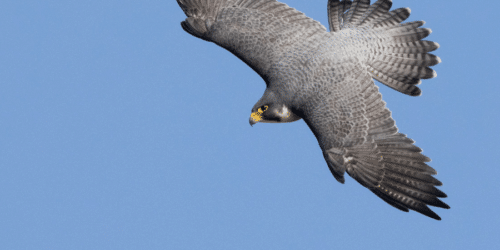
In this creative nonfiction piece, NCW virtual resident Chrystal Ho writes about PA and PB, the peregrines that fledged at the Norwich Cathedral earlier this year.
4th November 2026