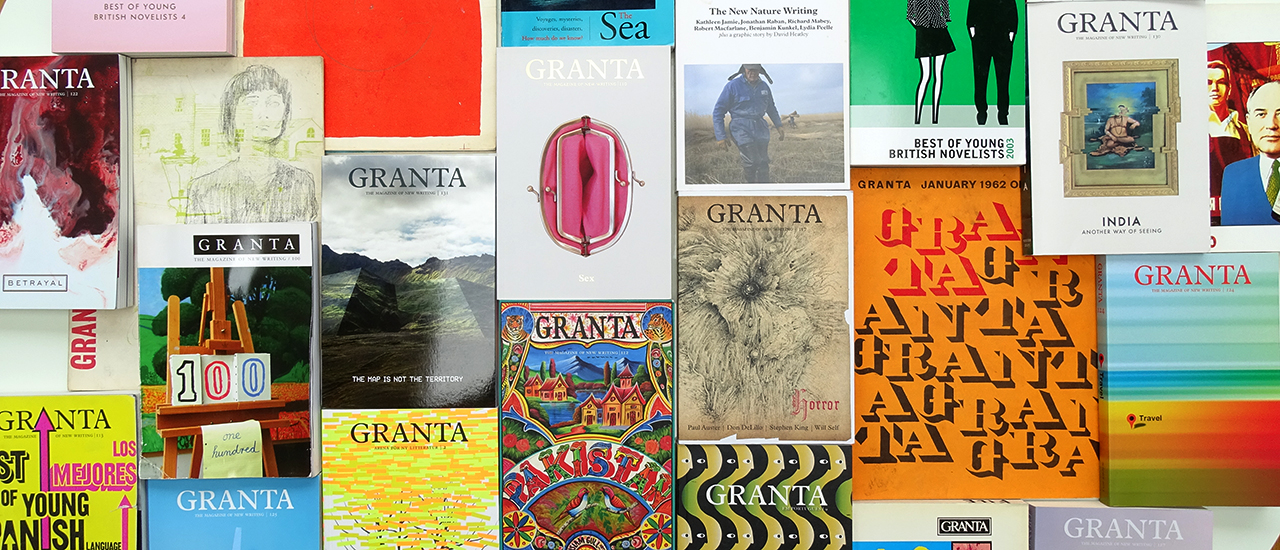
This month we’re celebrating Granta’s 40th anniversary. Today the Granta team share tips on writing and storytelling, drawn from their extensive archives.
Come to our Granta celebration at the Norfolk & Norwich Festival!
Here at Granta we love to talk to our writers about their process, about what inspires them and how they’ve overcome particular challenges or obstacles.
One piece of advice that surfaces regularly is to simply pay attention. Cormac James learns this from Elizabeth Strout by thinking about her novel My Name Is Lucy Barton while he carries sacks of plaster up the stairs for a renovation job:
Strout’s lesson kicked in later, telling me: it’s all there, right under your nose. It’s not something you have to research, root out, ponder, find. Pay attention and filter nothing. That’s all you have to do.
Anosh Irani compares the act of writing a novel to Werner Herzog’s film Fitzcarraldo, an adventure where the odds are stacked against you:
As human beings, all of us have a wound, a point of deep pain, and whether we are aware of this point or not, many of the decisions we make in life arise from this wound. What we think of as choices are, many a time, reactions. And if it is true in life, it is perhaps even truer in fiction. What is destiny if not a long string of choices, a reaction to the things that have happened to us? Destiny in life becomes plot in fiction.
This iconic scene from RuPaul’s Drag Race becomes a way to think about writing for Paul Dalla Rosa:
The thrill isn’t contained in the action itself, it’s something else entirely. It’s like a short story, a great short story. It appears, everything else fades away, then it’s gone. Miraculous. An act of transubstantiation, matter simultaneously changed and unchanged.
George Saunders and Ben Marcus, masters of the short story form, investigate its mysteries and the state of American fiction in this conversation. One of the most compelling and surprising pieces of advice given is that a formula doesn’t exist, one’s approach must change every time:
Saunders: Given that you read because you want to feel things, how does one (how do you) go about reverse-engineering that? In other words, how does the artist on the other side of that exchange impel his or her story toward becoming something that will cause feeling in the reader?
Marcus: This is what we’d all like to know, right? How the hell you do it. The unanswerability of the question is, at least in part, what draws me to it. Any specific, actionable insights I gain about how to write stories are woefully unstable. And disposable. A kind of single-use set of ideas that, in the end, might apply to a specific story I’m working on, but no more. In the end it’s hugely humbling to complete a short story thinking that I’ve figured something out, only to find that those ways of working and thinking are useless for a new story. You have to solve for x again, every single time.
In a moving piece about her childhood in a Lao refugee camp in Thailand, Souvankham Thammavongsa reflects on her father’s work as a craftsman and the importance of continuing to make art, no matter what.
I learn from this photograph that you must make your art, wherever you are, whoever you are, whatever you have. You must. This is something no one can ever teach a writer. She must find this for herself alone. Over and over. This must.
You can find all of our author interviews here, and our series on the craft of writing here.
Happy writing!
The Granta team
You may also like...

Writing poetry with Martin Figura
In this episode of The Writing Life podcast, we speak with award-winning poet Martin Figura about writing his latest poetry collection, ‘The Remaining Men’.

6th May 2024
Reintroducing Harriet Martineau with Stuart Hobday & Gaby Weiner
In this episode of The Writing Life, Stuart Hobday and Gaby Weiner discuss their new book ‘Reintroducing Harriet Martineau: Pioneering Sociologist and Activist’, and the the life and legacy of Harriet Martineau.
22nd April 2024

How to improve your poetry: top tips for aspiring poets
Embarking on a new poem can feel like an intimidating task for any poet. In this article, we share our top tips and a creative writing exercise that will help you have fun with your poetry.
18th April 2024