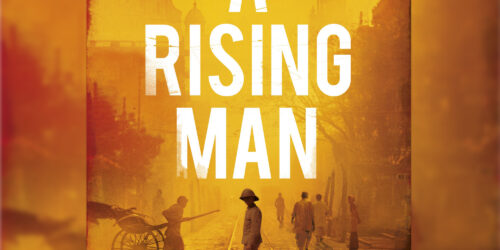
Over April and May, our (virtual) NCW Book Club is A Rising Man by Abir Mukherjee. We hope you’ll join us in reading the book, and that you’ll join the discussion in our Discord community or one of our Zoom discussion sessions.
In the meantime, here are some questions that you might like to consider or discuss with friends, family and fellow members of the Book Club as you make your way through the book.
We’d love to hear your thoughts on A Rising Man, and any other questions that the book sparks for you. See our post here to find out about all the different ways you can get involved. You can also catch a newly commissioned piece from Amir at the City of Literature strand of Norfolk & Norwich Festival. Register for free here.
Members of the Book Club can purchase A Rising Man with a 10% discount from our friends at The Book Hive – and there’s still plenty of time to read along with us!
Happy reading!
Reading historical crime fiction
This is the first piece of historical fiction we have read together for the Book Club. How does your experience of reading A Rising Man compare to our other Book Club reads, or other books you’ve read? Can you find any similarities and differences between Abir Mukherjee’s book and, for example, crime novel Bluebird, Bluebird by Attica Locke, or Mark Cocker’s historical analysis in Our Place?
A Rising Man transports us back in time to Kolkata, then known as Calcutta, in 1919. How does Abir Mukherjee orientate the reader in this time that is so different from our own? portray this setting? What techniques are used to create historical and geographical setting?
Abir Mukherjee doesn’t shy away from the realities of empire and the problems of the British Raj, the almost 90-year period of British occupation of the area that is now Bangladesh, India, Pakistan, and parts of Myanmar. How is this colonial context portrayed, and why do you think Mukherjee has chosen to use it in a crime novel? Would the story be different without this context, and if so, how?
Character and point of view
Sam Wyndham, the narrator-detective, is something of an outsider in both Bengali and British Calcutta societies. How is Sam’s strange position portrayed, and what does this allow Sam to do that others are not able to? Why do you think Mukherjee chose a sceptical British police officer as narrator? How does Sam compare to other crime fiction protagonists you have read, and what does it mean that we ‘hear’ the story from his perspective, in the first person?
Sam Wyndham has two deputies, the Indian ‘Surrender-not’ Bannerjee, and the British Digby. Aside from their nationalities, what differences can you find between Bannerjee and Digby? Do they offer different perspectives on the events of the novel, and if so, how? Thinking about other crime or detective fiction you might have read, are Bannerjee and Digby typical sidekicks?
As in any good crime novel, A Rising Man is populated by a cast of suspects, informants, and other characters. We encounter all sorts of people: from Salman the rickshaw wallah, to Anglo-Indian administrator Miss Grant; from Mrs Bose the madam, to Byrne, the travelling salesman from Ireland; from suspected terrorist Benoy Sen, to Sam’s landlady Mrs Tebbit. What perspectives do each of these characters offer to Sam (and us) as he carries out his investigation? Why do you think Mukherjee has included each of these, and what importance do they have for us as readers?
Plot, structure and theme
Throughout the book, Sam’s investigation competes with that of the military police, Section H. How do these two investigations twine throughout the book and shape the plot? Where do they meet and where do they diverge? Is a similar structure employed in any other books you have read, and why do you think Abir Mukherjee has included the second investigation in the book?
One of the key elements in Sam’s investigation is interviewing Benoy Sen, the suspected terrorist who seeks Indian independence from British rule. However, Sen subverts many of Sam’s previously held ideas about terrorism, fanaticism, guilt and redemption. What do you think about these themes, in relation to the character of Benoy Sen, but also in other parts of the book? Are there any other themes that stand out to you as you read A Rising Man?
One of the joys of reading crime fiction is trying to solve the crime ourselves as we read. Were you able to guess who the murderer was before the end? Were there any twists along the way that surprised you or derailed your investigation? How has Abir Mukherjee directed and deflected our attention at different points of the story?