


In this episode of The Writing Life Podcast, Dieter Rogiers explores how place shapes his writing, discussing both the locations where he writes and the international settings of his novels.
Dieter is a Belgian author, film critic and copywriter from Brussels. Selected in 2004 as one of ten promising young Flemish writers, Dieter has written several award-winning short stories and graphic novels, including De Wraak van de Walgvolgel (The Dodo’s Revenge), Tunguska and De parelvisser (The Pearl Fisher).
His residency in Norwich City of Literature was part of our exchange with Passa Porta house of literature in Brussels.
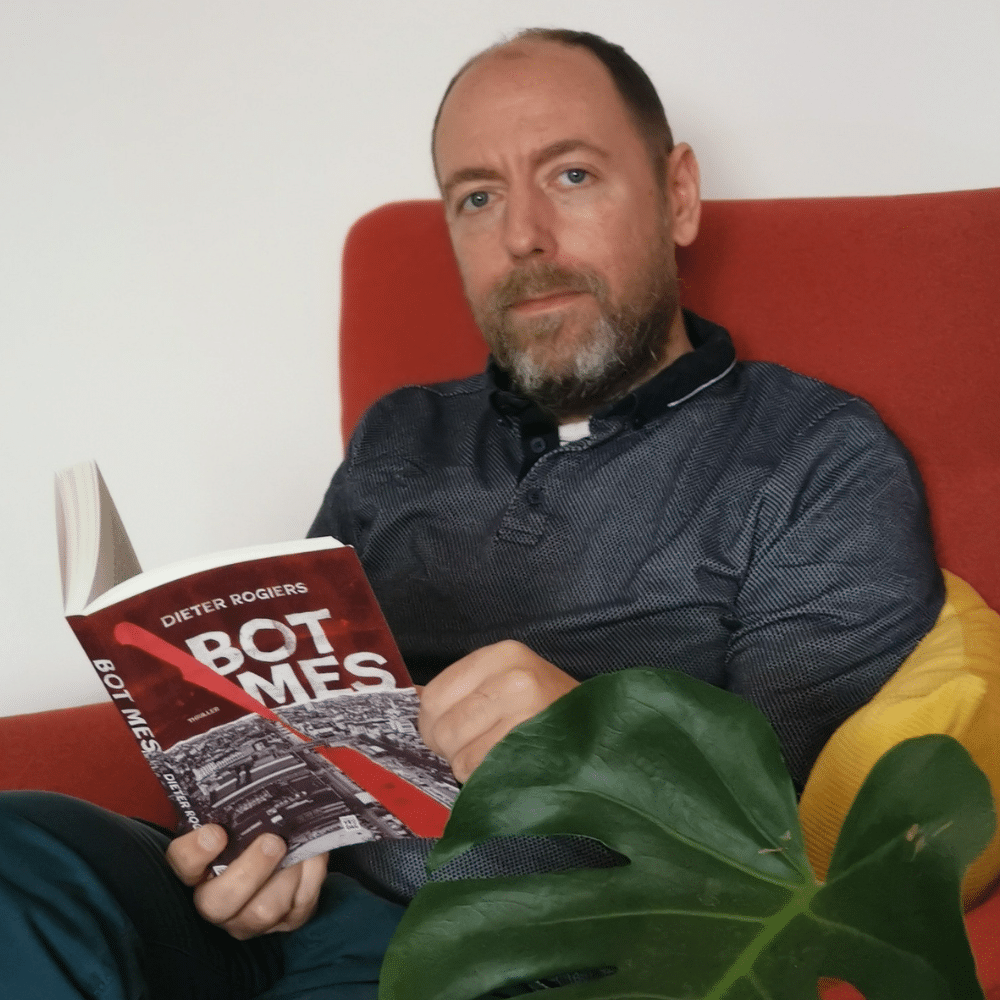
Dieter sits down with Quaid Cey, a recent alumnus of our Emerging Translator Mentorships Programme, to discuss the role writing residencies have played in his career and how he researches the diverse settings of his fiction. Their conversation also covers the Kishōtenketsu narrative structure, how living in Brussels has influenced and shaped his writing, and the importance of stepping away from everyday life and dedicating time to your practice.
Listen now
Edited by Omni Mix
Transcript
Quaid
Thanks for making time to chat with me today, Dieter. I wanted to begin by congratulating you on being selected for the writers’ residency at Dragon Hall, hosted in collaboration with Passa Porta International House of Literature in Brussels.
As I understand it, this isn’t your first time being invited abroad to spend time focusing on your writing. In the past, you’ve been hosted for similar stays in Groningen, Bratislava and Tallinn, amongst other places.
Can you tell me a bit about the role these residencies play in your career as a writer?
Dieter
Yeah, sure. Maybe I should set the record straight first. I did indeed write parts of my first novel in Groningen, Bratislava and Tallinn, but those weren’t really residencies. It was basically me taking a month off from my job to go and write somewhere far away, where nobody could find me.
The Dragon Hall residency was my first official stay, so to speak. But the effect was the same, and for me, that’s what matters.
The hard part of writing for me isn’t the writing itself. It’s more about finding a routine and making sure you hit your target at the end of the day. I usually set myself a target of about 1,000 words a day.
If I want to do that while staying at home, it’s mostly a fantasy, because you always have a friend ringing to ask if you want to have a beer, or the neighbour drilling a hole in the wall at the worst possible time. Or my partner decides to have a conference call without telling me beforehand, and stuff like that.
That’s why I like to go away and write somewhere else. The residency at Dragon Hall was a beautiful place to do that, to be honest.
I mean, I don’t have a shed like Roald Dahl used to have at the back of his garden. I don’t really have a garden, to be honest. But while staying at Dragon Hall, I noticed that being there did half the work for me, basically. It really felt like stepping into a Jane Austen-like writing chamber. That whole 19th-century fantasy of being a novelist really came through there, sitting at your desk, staring out of the window and looking over the garden terrace.
So, yeah, I loved every minute of it, and it allowed me to get some really good writing done. Do residencies play a role for me? Absolutely. It’s where I do my best writing, I think.
Quaid
Wonderful. Yeah, I guess it’s about taking yourself seriously, isn’t it? When you go on these residencies, or when you go abroad and dedicate that time to your writing, it’s a way to step away from the everyday and really take your role as an author more seriously, isn’t it?
Dieter
Yeah, absolutely. I think, like every author, you do sometimes suffer from what they call imposter syndrome. You feel like you’re just winging it and hoping to get where you want to be.
Spending time at Dragon Hall, especially, made me feel like a real writer, partly because I was sharing the cottage with another writer from Flanders, Anaïs. That helped as well. Every time we talked, we discussed how I write and how she writes, and it’s totally different. It broadens your perspective on what writing is and what writing could be, and it really helps you along.
It was also great talking to people from the National Centre for Writing in Norwich and hearing how they think about writing, drawing on their own backgrounds, whether that’s writing novels or translation.
Yeah, I find it really adds to the experience.
Quaid
Definitely. I wanted to talk about this co-living or co-residency experience you had with Anaïs. I believe we’re going to be talking with her later this year as well.
I wanted to ask you a bit more about the experience of being around other writers, because I know that sometimes, in our everyday environment, we don’t come across other writers or translators, and I know you also translate.
I think there’s something really beautiful and helpful, career-wise, about being immersed in an environment with other people who have made that their life’s work.
Dieter
Oh yeah, absolutely. The nice thing about Norwich, especially, is that there seems to be a writer around every corner.
Whenever I was doing writing-related work, not necessarily writing but rewriting, I liked to go out to a local pub or café, have a coffee or a drink, and sit there with my laptop. Once every few days, someone would come up to me and ask, ‘Hey, what are you doing? Are you writing?’ You start talking, and it turns out the other person is a writer as well.
Then you start exchanging experiences of writing itself, getting your book published, and all the things that come with it, such as promoting yourself and your book. These things enrich your experience, absolutely.
That’s one of the main things I’ll remember from my stay in Norwich. I got in touch with a couple of writers who I’m still in contact with: local writers from Norwich, working in all kinds of different genres and at all kinds of different stages in their careers.
It’s so nice to talk to other people about what it means to be a writer. I mean, it’s different for every person. I’m not a writer because someone else is a writer, but we’re all trying to bring something that will get someone excited about reading what we’ve written.
That’s something communal that really happens when you start talking to other writers. So I really enjoy that, yes.
Quaid
I’m glad to hear that. I wanted to ask a bit more about the work you were doing during your time in Norwich.
During your residency, you were focusing on developing a short story you recently wrote. In Dutch, it’s called Een Goede Dood, and in English, A Good Death.
The story centres on a protagonist who makes a living cleaning up the apartments of the recently deceased and who is also struggling with a history of loss of his own.
I hear that your plan is to turn this story into a full-length novel, building on the East Asian kishōtenketsu tradition, which is a four-part storytelling structure consisting of an introduction, development, a sudden twist and a conclusion.
I wanted to know if you could tell me a bit more about this project: why you’ve chosen the kishōtenketsu model, and why you’ve decided to set your third novel in Japan.
Dieter
Well, the original idea had been in my head for quite some time. It was mostly because my mum, in the final years of her life, led a rather secluded life.
We often had some very heavy quarrels, some really big fights, so sometimes I wouldn’t speak to her for weeks. That planted a kind of fear in my head. I would think, ‘Well, what if we fight and then she suddenly dies, and she could be lying in her apartment for weeks before anyone actually notices?’
She might become one of those newspaper stories you sometimes read about, where the neighbours call the police because there’s some kind of smell coming from the apartment. That’s not the kind of thing you ever want to experience, right?
So, the first version of the novel was quite macabre, actually. I was describing how a decaying body experiences the time between dying and being found. I still think there’s a good novel in there somewhere, but that’s not the novel I’m currently writing.
When I look at the things I wrote back then, I notice that I wasn’t writing about the decaying body at all. I was writing about memories and how those memories are attached to objects in the room where she was lying.
So, that was basically the start of everything, and it evolved from there.
Then, last year in May, my mum actually died, quite suddenly in the end. When my sister and I were cleaning her apartment, we kept finding things that clearly meant something to her. But it was hard for us to know exactly what those things meant to my mum.
Why had she held on to them? Let me give you an example. She had a letter I’d written for Mother’s Day when I was about seven or eight years old. I wrote a letter every year, but she only kept one of them: that specific letter.
To this day, I don’t know why, and I’ll never know why, but it got me thinking: why had she held on to it? Was there a memory attached to it? And if there was, was there some way for me to recover that memory from her? Is there a way to define what kind of memory was held within it?
So, that’s what the novel is about now. It’s basically a novel about the things we leave behind, the memories that come with them, and how, after our death, we pass those things and memories on to friends and family, sometimes from one generation to the next.
Quaid
Yeah. So, how did you decide to take that story, which is so closely connected to your personal life, and develop it into a more universal topic about death and the things we leave behind? How did you decide to transpose it into a Japanese setting and follow the kishōtenketsu model?
Dieter
Well, I didn’t want to put myself in there as a protagonist. I didn’t want it to become some kind of fictionalised memoir. That’s the last thing I would have wanted.
I did want to broaden the story out a bit. And then, as often happens when you’re writing something, something serendipitous happens, and all of a sudden, all the pieces of the puzzle start falling into place.
For me, that moment came when I read an article in, I think, The New Yorker magazine. It was about a Japanese woman, a relatively young woman, who had made it her job to clear up apartments after people had died lonely deaths. Apparently, this is quite a big problem in Japan. Society there is crumbling a bit, so to speak, because people don’t really form the connections they used to, and lots of people live by themselves.
In the article, she said something that, for me, cracked open my whole idea of what the novel could be. She said that she didn’t treat the things she found as objects. She treated them as memory containers.
For me, that was the moment when everything clicked. I thought, ‘Oh, wait a minute. Now I can find a good protagonist.’ I could create a protagonist who collects memories from strangers, basically, so that their families can move on.
That’s where the novel is at the moment. The main character has his own issues, including the death of a brother, which he hasn’t been able to process. There’s this void inside him that he needs to fill, and he does so by helping other people, when he should really be helping himself deal with his own problems.
That led me further down the rabbit hole of trying to understand how people deal with loss and memories. I discovered that the way we deal with death in the West is completely different from how it’s done in the Far East, for example. Actually, I’d say the same applies to how we approach life in general.
For us, it often comes down to identifying an obstacle and then overcoming it. That’s it. The same applies when someone dies: someone dies, you have to deal with it, and then you have to overcome it.
But in the East, it’s more about finding a balance and making sure that, after something happens, that balance is maintained and you learn from what’s happened.
Then I discovered that this approach is woven into storytelling traditions in China, Japan and Korea. That’s where kishōtenketsu comes in: a story structured not in three acts, as we mostly have in the West, but in four.
For example, I guess you’ve seen the Korean film Parasite?
Quaid
Yes.
Dieter
That film uses the kishōtenketsu structure. For the themes I want to explore in A Good Death, I found it perfectly suited. So that’s why I’m using it.
Quaid
Very interesting. I think I’m probably not the only one who hadn’t come across this storytelling tradition before we decided to meet and chat today.
Can you tell us a bit about the third element? So, we have an introduction, a development, and then a sudden twist: an unexpected event that leads to the eventual conclusion.
Can you tell us a bit more about that and how it relates to your story?
Dieter
It’s a twist, but not a twist in the sense that we understand it in Western literature. In Western literature, a twist is something sudden that happens, changes everything and causes the lead character to act in a certain way.
Here, it’s more about a different perspective. That’s the ten, as it’s called, the third part. You’re presented with a situation that has been established by the first two parts, and then you look at it from a completely different perspective.
That causes the lead character to look at parts of his own life from that different perspective as well. That’s how he learns from it and finds a new balance in life.
It’s something that doesn’t really involve a lot of conflict, which is something I sometimes struggle with, because you’re so used to writing with a conflict in mind and putting characters in opposition to one another to create drama.
Here, though, it’s more about, well, I guess it’s similar to how a haiku works, in a sense. A haiku has three separate parts, whereas kishōtenketsu has four. With kishōtenketsu, you could say that the first two parts are condensed into one part in a haiku. But it’s a similar idea.
There’s also always a link with nature. Something happens in my novel, in this case, and that’s death. Death is everywhere. It happens all around us. It’s just part of life, part of nature, and there’s nothing you can really do about it.
So, yeah, I think that’s why I chose this structure, because it’s so well suited to the story I want to tell.
Quaid
Nice. Well, we’ll all be very excited to read more when it’s available.
Keeping with the theme of how death features not only in this work but also in your other works, I want to rewind a bit and change locations, going from Japan back to Brussels, which is the setting of your debut novel, Botmes, which translates as Dull Knife.
It’s a thriller about the death of a young woman, Arianna, whose body is recovered from the Brussels canal. After being asked by the police to identify his daughter’s body, Arianna’s father, a jaded journalist who spent many years living in Brussels before turning his back on the city and vowing never to return, embarks on a mission to unravel the mysterious events leading up to her disappearance. This plunges him into the world of underground art smuggling.
Just as interesting as the mystery itself is your futuristic, semi-dystopian depiction of Brussels. In your story, Belgium has officially split into two independent states, Wallonia and Flanders, for those who aren’t familiar with the country’s political divisions. This leaves Brussels as a kind of in-between, or no-man’s-land, where crime and corruption are running rampant. It’s sort of a Belgian Gotham, if you will.
There are various instances in the novel where you describe Brussels, its evils and its strange allure, at least for the protagonist. I’ve translated a few quotes that I find particularly interesting.
On page 66, your protagonist claims, ‘I had once compared Brussels with a lumbering anaconda that slowly, painfully squeezes the life out of you without even the decency to swallow your carcass when it’s done.’
Later, on page 116, one of your characters says, ‘You can hate a city and still love it. You can dream of fleeing and still never pack your bags.’
Finally, in the acknowledgements, you write, ‘Thank you, Brussels. You’re dirty, frustrating, frightening and bizarre. But your irresistible, surreal charm continues to inspire me.’
As I was reading your book, it struck me as a kind of love letter to Brussels. So I wanted to ask you what exactly that surreal charm means to you, why it inspires you, and how your years of living in Brussels have influenced or shaped your writing.
Dieter
Yeah. Well, I first came to Brussels, or really settled in Brussels, in the mid-90s, when I went to film school here. I mean, you know Brussels, right?
Quaid
Yeah, I live in Brussels currently.
Dieter
You live in Brussels, right? I mean, what was your first impression when you first encountered the city? I find that most people have a similar reaction. They say it’s dirty, rude, badly kept, and a bit like a labyrinth you have to find your way through.
Do you have the same opinion of it?
Quaid
Yeah, I must say that when I first visited Brussels as a tourist, I found it a bit chaotic. I definitely had a short adjustment period when I first moved there.
But I always tell people, when I’m talking about Brussels, that it’s a city that gets better the more time you spend there. It’s a city that really, I don’t know, finds a way into your heart after a while. And once it’s there, you can’t get rid of it.
So I can definitely relate to those descriptions.
Dieter
Yeah, absolutely. As far as first impressions go, Brussels always fumbles it. Wherever you’re coming from, if you arrive at the Midi station from England, for example, your first reaction is, ‘Damn, what kind of city is this? It’s so dirty and so ugly.’
But, as you said, the longer you stay, the more you start noticing things you like about the city.
Brussels is made up of 19 small communes, and it feels as though it’s being built by 19 different architects all working on the same building at the same time. The building looks horrible, but somehow it’s still this living, breathing thing, and it works.
That’s what I like about it. It shouldn’t work, but somehow it does. It’s almost like a metaphor for the human condition, I find.
That’s why I’m always inspired by Brussels: it keeps surprising me. Every time I’m ready to give up on the city, something happens and I think, ‘No, there’s still beauty here. There’s something we can build on to make Brussels a better city.’
That’s what I like about it, and that’s where the inspiration comes from. It’s also the Brussels I wrote about in Botmes, my first novel.
I know the place inside out. I’ve been living here for 20 or 25 years, and I think that, for a lot of readers, my description of Brussels is a bit grimy and all. People who have only visited the city a couple of times will probably recognise that.
But I hope that, by the end of the novel, having written about how much beauty there can be in the ugliness of Brussels, readers will start to see that as well. They might also realise that there’s beauty in things you actually hate, and vice versa: there can be things you hate about what you love.
Once again, that’s part of the human condition. It’s always about nuance. Nothing is ever really black or white; there’s always a grey area. And if there’s one city that really embodies that grey area for me, it’s Brussels.
Quaid
Yeah, sometimes quite literally, given how gloomy it is all the time.
You definitely strike a nice balance between praising the city and criticising it. I think that lends itself very well to the novel itself, which deals with some pretty dark themes. Of course, we began this part of our conversation by talking about death, and that’s certainly a major theme in the novel as well.
You have a history of exploring these themes. You write thrillers and often bring in elements of crime, the underground world, things happening behind the scenes and political corruption. These themes seem like an interesting and very apt fit for a city like Brussels, which is politically complicated, a bit grimy and dark, and has a rather murky history of its own.
Dieter
Yeah, indeed. I like the way you described it as a Belgian version of Gotham, because I’d never really looked at it that way before, but you’re kind of right. It is like that. It has this seedy underbelly that’s always there.
But then again, something glossy is built on top of it. Just look at the European Union and all that. You have these huge buildings that are nothing but windows reflecting everything around them.
So, yeah, the contrast between those two things is what makes Brussels so interesting. I don’t think it’s a coincidence that surrealism started in Belgium and Brussels, because everything you see around you is quite surreal.
Quaid
Definitely. I think one of the strongest aspects of your book is that you create such a vivid sense of the city. That leads me to another question about the importance of place in your work.
I was asking you earlier about why you decided to set your newest book, A Good Death, in Japan, and we’ve just discussed your love-hate relationship with Brussels in your debut novel. But I also want to talk about your second novel, which could be translated into English as The Moscow Film Club.
As the title suggests, you take the reader to Moscow. The novel is set in the years leading up to the fall of the Soviet Union and follows a young woman named Valentina who works at a film censorship agency. Her job is essentially to cut sections from Western films that would be banned in the Soviet Union because they don’t align with the regime’s values.
As I was reading the first half of your book, at least — I haven’t had a chance to read the second half yet, as you’re still working on it —
Dieter
Well, it’s still a work in progress, yes. I’m still working on it. I think I’m on chapter 62 out of 78, so I’m almost there, but not quite yet.
Quaid
Nice, you’re getting close, then. I’ll be really excited to read the second half, because the first half was very suspenseful and also so deeply rooted in the period you’re trying to depict.
Dieter
Yes.
Quaid
And so, it feels very contemporary, obviously, because you’re the one writing it. But it also feels distinctly rooted in the Moscow of that time: the characters and the things they do, the conversations they have, the dialogue, the specific types of jobs they do, and the central conflict, which I won’t reveal.
All of this feels very true to the period. I’m curious to know how you, as an author, were able to form a connection not only with Moscow as a city, but also with that particular version of Moscow.
Dieter
Yeah. When I started writing this novel, I didn’t set out to write a novel set in Moscow. I wanted to write something about films, because that’s a real passion of mine. The idea was to explore films and how they can shape a society.
Then I discovered that Moscow, specifically Moscow in 1984, was an ideal time and place to tell that story.
That’s a bit awkward, because the only Russia I know is through films, books and newspaper articles. I was 11 years old when the Berlin Wall fell, so the Cold War isn’t really a core memory for me. And I’ve never actually set foot in Russia.
I had the chance to go there. A very good friend of mine has been working at the Belgian embassy in Moscow for the past few years, and whenever I spoke to him, he’d say, ‘Come on over. I have a room set aside for you here.’
But with the whole geopolitical situation, you never quite know when the war in Ukraine is going to escalate. The last thing I wanted was to be stuck in Moscow for a couple of months if something happened. So, in the end, I decided not to go.
But there’s another reason I decided not to go, because I don’t know if you’ve ever read The Go-Between by L. P. Hartley.
Quaid
No, not yet.
Dieter
It’s a beautiful novel, and I think it has perhaps the greatest opening line in English literature: ‘The past is a foreign country; they do things differently there.’
Quaid
Yes, this line I’m familiar with.
Dieter
So I thought, ‘Okay, if I go to Moscow, my friend can show me Moscow, but he can’t show me 1984, because that Moscow doesn’t exist anymore.’
So why exactly would I be visiting? That’s why I decided to rely mostly on memoirs written by people who lived in Moscow, Russia or the Soviet Union, as it was called back then, and use those as my basis.
There was also a really, really good photo book called A Day in the Life of the Soviet Union. In the mid-80s, the Soviets invited some Western journalists over and allowed them into the country for a couple of days, under certain restrictions, of course. But they were able to take photographs of everyday life all over the Soviet Union.
It’s a really big picture book, with these beautiful, typically 80s, grainy photographs. They really gave me a sense of the time and place, so that definitely helped me get into the mindset of Moscow during the Soviet era.
Quaid
Right, yeah. I was going to ask you how you go about researching your books, because not only in The Moscow Film Club but also in your previous work, there’s such a strong attention to detail. I think that’s one of the things that stood out to me most in your writing and that I appreciated most, because, as someone who doesn’t necessarily write the kinds of books you do, I find it really impressive.
I’m talking about the cultural references, of course, but also the little markers of place and even the sense of direction, because when you’re reading certain scenes in your books, you can really imagine yourself in a specific location within the city. Perhaps that comes from the photographs and descriptions you find in the books you’ve read.
But even the character descriptions have their place in the novel. You include details that don’t necessarily push the plot forward and could potentially be left out without really affecting it, yet you make sure to include them. I find that really impressive.
As I was reading, I kept thinking, ‘God, this must have taken hours and hours of research.’
So, yeah, I’m curious to know more about your research process, both for this book and for your writing in general, as well as for your upcoming book set in Japan. I imagine that requires a lot of research, too.
Dieter
Yeah, absolutely. I enjoy the research, if I’m honest. That’s part of the fun of writing something like this. When I’m reading a book, part of the enjoyment comes from stepping into a completely different world and getting to know the people who live in it. That’s what I want to create when I’m writing myself.
For The Moscow Film Club, in particular, I had memoirs written by people who lived during that era. I got to find out what kind of cigarettes they smoked, what they did if they wanted to bribe someone, and how they got hold of things that officially didn’t exist, which happened a lot in the Soviet Union, of course.
Dozens of these anecdotes have found their way into my novel in one form or another. You strike gold when you read something like that. You think, ‘Okay, this really gives the reader a good idea of what it must have been like to live in that era.’
Especially with the Soviet Union, because it wasn’t just a country. It was a kind of mindset, a way of looking at the world that existed during that particular period.
It was really helpful for me to get into that Soviet mindset by reading a book by Karl Schlögel. He’s the pre-eminent person to turn to when you want to talk about the Soviet Union. Over the course of about 40 years, he wrote lots and lots of essays, which he later collected in a book called The Soviet Century: Archaeology of a Lost World. The title alone is amazing.
It’s about 900 pages long, and I basically read it cover to cover over the course of a couple of days because, once I started, I couldn’t stop. When I reached the final page, I thought, ‘Okay, now I kind of understand the mindset I need to be in to write this novel.’
That was really helpful.
Another thing I did was reread some Russian literature. It’s very unlikely that I’m going to write something as good as a novel by Dostoevsky or Tolstoy, but reading their work helps. It gets the rhythm of the language into your ear: the idioms they use, the way they tell a story and the way they describe characters.
I definitely wanted to draw on some of that Russian storytelling tradition in my novel, so that was another thing I did.
And then, because the novel is also partly about films, I obviously watched quite a few films made back in the day, in the 70s and 80s. That was helpful for seeing what the city looked like, but also for observing how people interacted with one another.
Of course, a lot of those films contain quite a bit of propaganda, but propaganda also tells you a lot about what the state wants you to know and what it doesn’t want you to know.
Quaid
Your passion for research and for making your stories as true to the cultures they’re set in really comes across. It’s evident even on a page-by-page level, because you have all these little asterisks throughout your writing that link to footnotes, where we get wonderful little details about a specific type of vodka or a particular Russian term, for example.
Dieter
Yeah, my editor wants me to get rid of most of those asterisks, so I’m not sure how many will survive into the final edit.
But for me, they’re also handy footnotes for my own use. They help when I reread and re-edit the novel, allowing me to get back into it. As I told you, it’s a 500-page novel, and I’m on page 400 or so now.
I’m still aware of what I wrote on page five, of course, but it’s been a while, so the footnotes are helpful for me as well sometimes.
Quaid
Yeah, definitely. I selfishly hope you manage to keep the footnotes in, because I found them not only entertaining, as I learned about Valentina and her story, but also educational. I think you really managed to convey all the copious amounts of reading you’d done in a very digestible format, so kudos to you for that.
I wanted to ask a bit more about your research process. In the case of Moscow, you mentioned that you’ve never actually set foot in Russia. But, generally speaking, since you write about different locations, how important is it for you to be able to travel to the places you want to write about?
Dieter
I think that, if you’re writing a contemporary novel, it’s essential. It’s basically non-negotiable. These days, with the internet, it’s so easy for people to point out things that aren’t quite correct, and you don’t want to be caught taking certain liberties, because for some readers, that will take them completely out of the novel. You don’t want that.
I could never have written Botmes if I hadn’t lived in Brussels.
But if you’re writing about the past, I think it’s different. The further back you go, the less it matters, I think, because, for me, it’s not necessarily about building a place as accurately as possible. It’s more about building an arena that people believe in.
Sometimes it’s better to use a trope that you know isn’t entirely true but that people believe in, rather than something that was actually there at that particular point in time. That can make it easier to suspend disbelief, if you want to put it that way.
I once read that Bram Stoker, the author of Dracula, never went to Transylvania. That’s strange, because the idea people all over the world have of Transylvania is that it looks the way Bram Stoker described it in Dracula, right?
Quaid
Exactly, yeah.
Dieter
I mean, Franz Kafka had an unfinished novel called The Man Who Disappeared, I think it’s called in English. It’s about people emigrating to the USA, but Kafka himself never set foot in the country. He basically relied on what people who had emigrated told him, and he used that as his basis.
That’s actually the kind of template I’m using for The Moscow Film Club now. If it worked for Kafka, why couldn’t it work for me?
Quaid
Yeah, of course. Well put. I think that, as long as the mythology is strong enough, you can lean into that. We see it with all these contemporary reinterpretations of classical history, for example.
Often, it’s probably impossible for us to imagine what life would have been like back then. But if there’s a strong enough basis for making conjectures about life in that period, people will suspend their disbelief. They’ll be willing to read on for a few more chapters and find out what happens next.
Dieter
Yeah, absolutely.
Quaid
I wanted to ask what makes you choose narratives that require so much research, because this is true of everything of yours that I’ve read. Why not choose something that’s, let’s say, ‘easier’ to write?
Dieter
It’s kind of like the reason President Kennedy gave in the 60s for going to the Moon. We do these things not because they’re easy, but because they’re hard. That’s the pleasure of it; that’s the fun of it. It’s not about the destination, but the journey.
I would never want to get stuck in a rut, rewriting the same thing over and over again just because the first one was a success. I don’t want to keep doing the same thing. That’s just not in my nature. I like to challenge myself.
Ten or 12 years ago, I set myself a challenge that lasted a whole year. I decided to write 300 stories, flash fiction stories of 300 words or fewer, over the course of a year. So, basically, one 300-word story every working day.
Quaid
Wow.
Dieter
And this was in English, mind you, not Dutch.
So, was it easy? No. There were days when it was just brutal, sitting down and writing a story for that day.
But then again, it was probably the most exhilarating year of writing I’ve ever had. Every day, you’d try a different genre. Every day, you’d try to do something different from the day before, the week before or even the month before.
So, I guess that’s what writing is about for me, at least. It’s about challenging yourself and trying to do something you haven’t done before.
In some ways, I’ve already written my city thriller with Botmes. Maybe I’ll write another one in a couple of years; that could well happen. But in my mind, it’s like, ‘I’ve done that. Now let’s move on to something else.’
Sometimes, that might be something that comes more easily to me. But most of the time, I’ll challenge myself and choose something that has an element that’s quite difficult to pull off. And I know I want to do that because it’s going to make me a better writer.
Quaid
I wanted to ask a bit more about the challenges of writing a thriller specifically. You just mentioned Botmes, your city thriller set in Brussels, and I got a glimpse of the process of writing that book through a separate short story you wrote called De Parelvissers, or The Pearl Fisher in English.
In this short story, the protagonist is a thriller writer who reflects on the highs and lows of writing thrillers. He also talks about the recipe for a good thriller, breaking it down into the most basic ingredients that are always needed, and how he eventually gets tired of reusing those same ingredients.
I wanted to ask whether you genuinely believe there’s a formula for a good thriller, and whether it really is as simple as that.
Dieter
I think there is a formula, yes, but it comes with some caveats. Even when you sit down determined to break the formula, if you reread what you’ve written a couple of months later, you’ll start to notice, ‘Wait a minute, I was following a formula, but maybe not the one I expected to follow.’
Take James Joyce’s Ulysses, for example. It’s the great rule-breaking novel. But structurally, he basically lifts the entire structure from Homer’s Odyssey. So even as he was breaking the rules, he used a basic structure for his novel that Homer had established 2,600 or 2,700 years ago.
With thrillers, I find that this formula, this structure, is particularly important because your reader expects certain things from you. In the first act, there has to be a corpse. In the second act, there has to be at least one twist, and probably more than one. And in the third act, you basically have to tie up all the loose ends so that it’s believable who the culprit is.
If you mess with that, I think you’ll be in trouble when writing a thriller.
But the thing is, you can’t be too formulaic either, because then you risk the reader saying, ‘Wait a minute, I’ve read this before, and I’ve read it better than it’s written here.’ That’s the last thing you want.
It’s always a tightrope, right? I mean, take The Murder of Roger Ackroyd, probably my favourite of her stories. When Agatha Christie wrote it, a lot of readers and critics didn’t really like it because she was doing something new. But now it’s considered a masterpiece of how to use an unreliable narrator.
Still, it’s a classic Agatha Christie novel. Everything you expect from an Agatha Christie novel is there, and yet she still managed to innovate.
So I think that’s the ideal to strive for: stick to the formula, but still do something new. It might be something big or something small, but the key is to innovate within the structure that’s already there.
Quaid
Right. And how do you see this relating to the work you’re doing right now on A Good Death? As we’ve already mentioned, you’ve chosen a four-part structure that you had to research yourself after coming across it while deciding how to tell your story.
I’m curious to know whether you’re also trying to do something a little innovative with that four-part structure.
Dieter
I kind of feel like I have to, because I’ve noticed that I’m running into some walls while writing it. That’s mostly because the whole kishōtenketsu structure isn’t about conflict. It’s about realisation, basically. It’s about looking at things from a different perspective.
But all my life, I’ve been surrounded by novels, films and comic books that use the typical three-act structure we have in the West, and that requires conflict.
So I constantly have to restrain myself whenever I’m tempted to introduce conflict. In the beginning, I think I was restraining myself a bit too much, because by not including any conflict, I was basically writing a novel that was just too boring.
Now I’m trying to introduce some conflict while still making it fit within the framework of kishōtenketsu. The conflict isn’t the most important thing in the novel, and it never will be, because I don’t want it to feel like a formulaic three-act novel.
But in small ways, in certain scenes and chapters, I do use it. And I don’t think there’s anything wrong with that.
As I told you before, even when you’re trying to break the mould, you’re basically just choosing another mould to fall into.
Even if I don’t use a three-act structure in this novel, I’m still using a four-act structure that comes from East Asia. So it all depends on your perspective.
Quaid
Right, yeah. I imagine that structure helps, even when you’re trying to be innovative and bring together your Western education as a writer with an Eastern tradition that you’re now learning more about and contributing to. I find that really interesting. It’s clearly something that has also influenced your crime and thriller writing.
I wanted to bring up a slightly different point about the same short story that helped me understand more about your process of writing thrillers. In The Pearl Fisher, you discuss the discrepancy between Brussels as it’s portrayed in conventional crime novels and the city as it really is, or at least as you’ve experienced it.
I’ve translated a passage from the short story that I think captures this discrepancy particularly well. You write:
‘In his writing, Brussels was a sombre grey jungle. He snuck in a happy anecdote here and there, or a juicy, likeable character, but even those had all but disappeared after 100 volumes. His literary city had become a dystopian fantasy, filled with vague memories of a recent, turbulent past, and his readers ate it up voraciously. His was the Brussels they wanted to see, the enemy, the feisty, rebellious province they would eventually tame. He had created a monster, and the enraged mob was standing at the door with flaming torches.’
I really liked this passage. I think it neatly sums up the conflict we discussed earlier. You go on to describe the gentrification taking place in Brussels and the way the city is being metaphorically tamed. As I was reading the short story, I couldn’t help noticing a certain bitterness about these changes and a sense of nostalgia for the Brussels of the past.
Given our conversation about the importance of setting and place in your novels, Dull Knife and The Moscow Film Club, I’m curious to know whether you see your writing, or writing in general, as a way of preserving the character of a place, for better or for worse.
Dieter
In some ways, I do, I guess. I mean, some scenes in novels are basically like photographs you take on holiday, right? Every time you go back to them, you experience the same thing you captured back then: the same place, the same mood, the particular way the light was shining that evening, or something like that.
But sometimes you forget that the picture is never entirely accurate. The picture is really an emotion. It’s not a dry fact; it’s the emotion you attach to it. That’s what you cling to. It’s not the scene as it actually was.
So, if I want to preserve the character of a place, it wouldn’t be about capturing its general character. It would be about preserving my opinion of that place in my writing, which is kind of what I did in my short story.
While I was writing it, what unsettled me was that the writer in the story had done it too well. He’d written about Brussels in 100 books, and for the people reading those books, that had become Brussels.
In some ways, I think I wanted to correct that when I wrote Botmes, which came after The Pearl Fisher. In my mind, The Pearl Fisher was a kind of dry run for Botmes.
With Botmes, I wanted readers to end up where I’d eventually ended up myself: in a city that infuriates me but that I still love, and where those two things can exist at the same time.
That’s there on the page now, and I hope some readers will come to think about Brussels in the same way.
But, yes, I think you always want to preserve something you see and put it on the page. That’s what excites a writer, I think: being able to express your opinion of a place, to share your perspective on what it’s like with someone who comes from a completely different city and a completely different background, and to make them say, ‘Yeah, I can see your point.’
I hope I managed to do that in my first novel, and I hope I can pull off the same trick in The Moscow Film Club and A Good Death.
Quaid
Well, I think you’re well on your way. Having moved to Brussels from abroad myself and spent only three and a half years here, I could already relate to the things you were saying.
So I think you’ve definitely achieved that goal of communicating something that is at once deeply personal and subjective, but also shared and, to some extent, universal.
Dieter
Yeah, it’s nice to hear that.
This summer in Brussels, they’ve put up this ugly blue cube at Place de Brouckère. I don’t know if you’ve seen it yet, but it annoys me. It really annoys me because, underneath that blue square — for the listeners, there would normally be these little fountains where kids can play.
Now, of course, those fountains aren’t operating, even though we’ve had quite a few heatwaves, with temperatures reaching 35, almost 40 degrees.
These kinds of little things often annoy me about Brussels. But then again, you see people reacting to them, and that’s one of the great pleasures. You see people speaking out against the mayor of Brussels, telling him, ‘Wait a minute, you’ve got to stop doing this, because this isn’t your city; it’s our city.’
Certain things are important to us, like having fountains where kids can play when temperatures rise above 35 degrees. That definitely takes precedence over an ugly blue cube in the middle of one of the biggest squares in Brussels.
I understand that it brings money into the treasury, but still, I think that’s one of the nice things I’ve discovered about Brussels. It’s one big, sprawling city that kind of does its own thing. But if you have enough people living there who try to steer what’s happening in the city in a different direction, change will happen, slowly but steadily.
And that’s nice to see.
Quaid
Yeah, I think there’s a strong sense of community in Brussels, even despite the feeling that sometimes there’s no community at all, or that the community is very divided, given that it’s such an international city.
I’m aware that we don’t have much more time to chat today, but I wanted to make sure I asked you one last question, which I’d say is really an all-encompassing one about your career.
I want to rewind all the way back to the beginning. I read on your website that you’ve been writing since you were a child and that you originally started out creating your own comic strips.
Now, of course, as we’ve discussed today, your work encompasses everything from thrillers to short stories and, although we haven’t mentioned it, even children’s books.
I’m always interested in how an author’s initial introduction to storytelling shapes all the work that comes later, even in the smallest ways.
So, for our final question, would you mind telling our listeners how those first comic strips have influenced what you do today?
Dieter
As a kid, I was an avid reader. I’m from a fairly small town near the Dutch border, and the library we had only opened twice a week, on Wednesday afternoons and Saturday afternoons, from two until five.
My routine was to arrive at two o’clock, take out five comic books, bring them home and make sure I’d read them by five. Then I’d take them back, borrow five proper children’s books, and those would see me through the couple of days until the library opened again. I’d return those five books, get another five comic books and start the cycle all over again.
So I was really into reading as a kid, especially comic books. It got to the point where my dad once banned me from reading them in bed after the lights had gone out. Of course, I didn’t listen to him. One night, he caught me reading a comic book after I’d gone to bed. He took it from me and tore it to pieces right in front of my eyes.
I still remember which one it was. It was a comic book called De Schildpadschat — I’m translating the title here, but it means The Turtle Treasure. It was from the Jommeke series, which you probably know, although it’s mainly known in Flanders. Everyone in Flanders grows up with it.
So, yeah, my dad tearing up that comic book is definitely one of the core memories I have from my childhood.
I think the reason I’ve always been so obsessed with comic books, especially at a young age, is that they give you the best of both worlds. They allow you to enjoy the thrill of reading, but you also get the amazement of watching the story unfold before your eyes in pictures.
You’ve probably noticed this in my writing. It’s still quite cinematic. I love describing things in a way that makes them leap off the page.
Quaid
Definitely.
Dieter
That’s probably something I learned from reading comic books, which is why I think it’s such a shame that kids don’t seem to read many comic books these days. At least, that’s what I’ve noticed in Belgium.
When I was young, there were still comic strips in the newspapers every day. I used to cut them out with my scissors and glue them together into a book so that I could keep reading them long after the newspapers had been thrown away.
But these days, kids don’t really do that anymore. They don’t even have the opportunity to, because there are hardly any comic strips in newspapers now.
I think that’s a shame because, for me, comic books were a gateway to the real world of reading. And if you lose that, you lose part of your reading culture.
So I hope people will start reading more comic books again, or encourage their children to read them, especially Belgian comic books, because they’re still the best in the world.
Quaid
Yeah, I’d say Belgian comic books are definitely the crowning jewel of Belgium’s cultural exports.
Dieter
I agree, yeah.
Quaid
Well, I think your love of the cinematic, the visual and the literary all come together in the books you’ve written.
I think people can definitely look forward to reading the second half of The Moscow Film Club when it comes out, as well as your upcoming novel, A Good Death. Hopefully, there’ll also be opportunities for these books to be translated into other languages, so that readers in the UK and elsewhere can continue to enjoy your work.
Dieter
Yeah, if you feel like translating it, feel free. I’ll be happy if you did.
Quaid
Gladly. All right, Dieter, thank you so much for chatting with me today and I wish you the absolute best of luck.
Dieter
Thank you, Quaid. Thanks a lot.
You may also like...
The spirit of place: Laurence Mitchell on Flint Country
In this episode of The Writing Life Podcast, Norfolk-based writer Laurence Mitchell reveals how he brought the spirit of landscape and place onto the page in his award-winning book, Flint Country: A Stone Journey.

24th August 2026

Finding balance in writing: Sithuraj Ponraj on working across languages, jobs, and genres
In this episode of The Writing Life Podcast, Sithuraj Ponraj shares how he balances his dual life as a cyber-policy specialist and a multilingual writer.
29th June 2026

Poets in conversation: Lewis Buxton & John Osborne on performance, humour, and place
In this episode of The Writing Life Podcast, Norwich-based writers John Osborne and Lewis Buxton discuss writing poetry for page and performance.
12th January 2026