


In this episode of The Writing Life Podcast, Anaïs Van Ertvelde explores what it means to write about disability through her essay collection Handicap: Een bevrijding (Disability: A Liberation), which considers both what the world tells us about disability and what disability can tell us about the world.
Anaïs Van Ertvelde is a Belgian writer and historian. She teaches at the art college KASK and writes books, essays, columns, and podcasts focusing on sexuality, gender, the body, and disability. In 2024, she released Handicap: Een bevrijding (Disability: A Liberation), which won the prestigious J. Greshoff prize for the best essay in Dutch.
Her residency in Norwich City of Literature was part of our exchange with Passa Porta: International house of literature in Brussels.
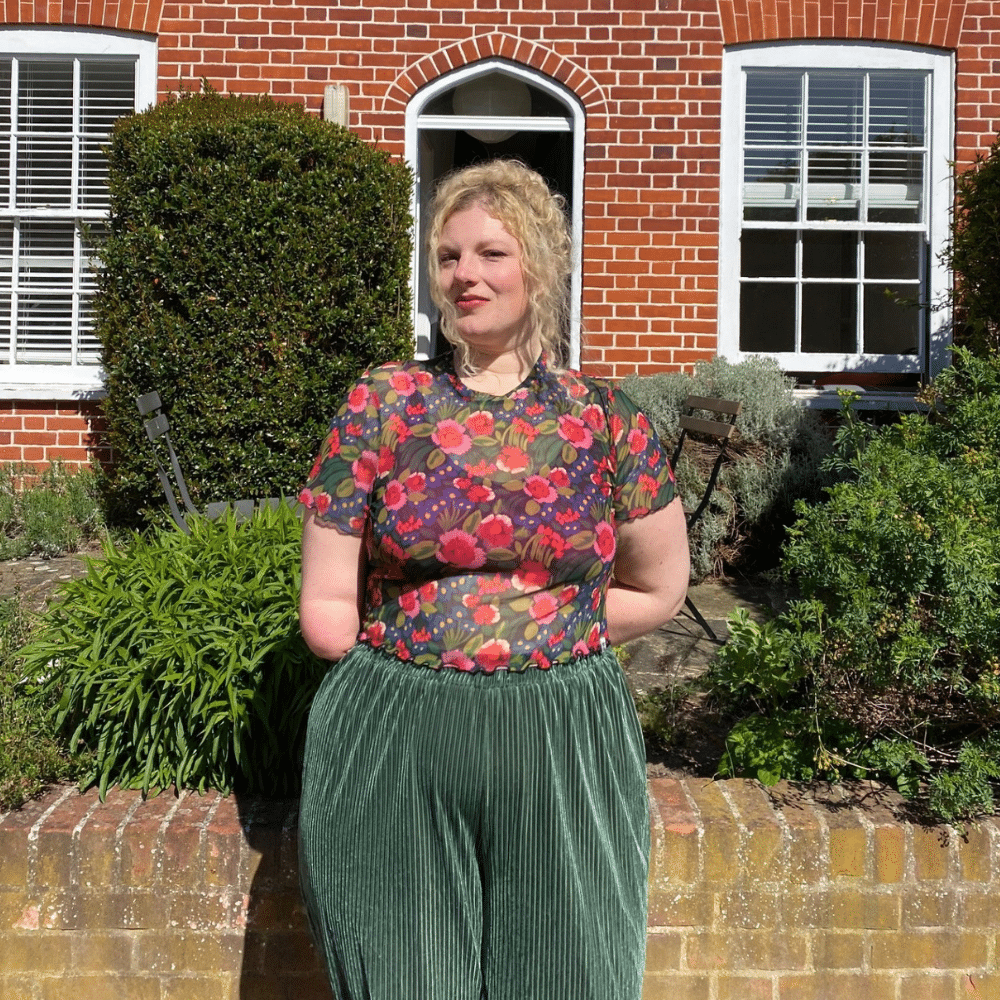
Anaïs sat down with Quaid Cey, a recent alumnus of our Emerging Translator Mentorships Programme, to explore her experience as a disabled writer and the process of writing this essay collection. They also explored her approach to writing about sex, her residency in Norwich and what the experience meant to her, as well as the challenges of writing for two different audiences.
Listen now
Edited by Omni Mix
Transcript
Quaid
Welcome, Anaïs. I wanted to start off our conversation by talking about your recent book, Disability: A Liberation, or in Dutch, Handicap: Een bevrijding.
Your book was published in January 2024 by Bezige Bij, one of the leading publishers in the Dutch language, and has since received a lot of attention on Goodreads, among other places.
I recently checked your Goodreads rating, and it looks like you have an average of 4.53 stars out of 5. Congrats on that.
Anaïs
That’s good to know, because I’m always afraid to check it, so I never do. And now I get to find out that it’s actually pretty good, yeah.
Quaid
Yeah, you’re way up there. I was also taking a look through some of the comments that your readers have left, many of which are very kind and celebratory, and one really stuck out to me. So I’m translating here from Dutch, but it says:
‘I feel so seen by this book, so acknowledged. I’d love to buy 100 copies and start giving them out, both for those who need encouragement and those who lack insight.’
They then go on to say, ‘After reading it, I feel prouder to call myself disabled. Finally, someone has written this book.’
So, yeah, I wanted to start off by just asking you: what does it feel like to receive that kind of praise from your readers?
Anaïs
That’s a very lovely compliment and also very reassuring, because the thing that I was most struggling with during the writing process is writing towards two different publics at the same time.
I really wanted to write towards the disabled public. I wanted to turn disabled people into an audience, because that really doesn’t happen all that often. Not in any art form, but also not in literature. Not in the Netherlands, not in the Low Countries, not in Belgium in any way.
We tend to write about disability, but we do not necessarily write for disabled people. When we write about disability, we often write for a non-disabled audience, and we want to teach them something about disability or how it is to live with a disability. But we don’t really write for disabled people. So I really wanted to do that.
But at the same time, I had to walk this tightrope in which I also wanted to write for a general audience who are not disabled, or who might think they are not disabled because maybe they are disabled but they haven’t really realised yet that they actually are part of this group as well.
So this was, I think, one of the main challenges in writing the book: that I could reach both those groups, people with and without disabilities.
And comments like these kind of give me the reassurance that I managed to do so, that I managed to write a book which informs people about disability. Like they say, people who lack insight, who don’t really know anything about the topic, who think it’s not a topic for them, it’s a topic that has nothing to do with their lives, that they shouldn’t be interested in.
But also people who are very deeply ingrained with disability and know a lot about the topic. And that I managed to talk to both those groups was very important to me. And I’m always happy that I managed to pull it off, or I think so. I mean, I have to start giving myself compliments now as well. I start this conversation off by complimenting myself, like, ‘Good job, Anaïs, you managed to do this.’
But that’s the feeling those kind of compliments give me. Like I managed to reach people with disabilities and people without disabilities.
Quaid
Yeah, I definitely believe that that’s what you did with your book. And that was something that I had also thought about before we decided to chat today, because you talk a lot about the idea of audience in your book, and you kind of talk about the absence of what you call a crip audience in a lot of other books.
I just want to note here that I’m using the term crip as you used it in your book, as a way of reclaiming a historical slur, similar to the way that people within the LGBTQ+ community identify with the word queer.
So you write in your book, and again, here I’m translating: ‘People with disabilities are rarely the target audience of art about disability. Should I not write for an audience of other crips? Are there enough of us to make an audience of our own?’
And so, yeah, I guess I want to just continue this conversation about writing for a crip audience and what that means to you, considering maybe the fact that other people aren’t doing this.
Anaïs
It also naturally comes out of my experiences in the publishing world, but also writing for newspapers, writing columns, where editors tend to want you to write for a non-disabled audience because that’s the bigger audience, especially in a small country like Belgium. It’s not even all of Belgium, because it’s only half of the country that speaks Dutch, so Flanders and maybe the Netherlands.
The group of people with disabilities, they think, is so small that if this is our target audience, it’s not very profitable. So you have to try and reach non-disabled people in the first place.
And I really wanted to write this book also as a statement that it is not the case, because there are so many of us. It’s not a small minority at all.
And I think I also play with this in the book, like the idea of not making those two audiences, which I’ve now delineated so very clearly. We have this audience of disabled people and of non-disabled people. But I also tried to play with that notion in the book. Maybe these aren’t two strictly separated audiences. Maybe there are more people with disabilities who don’t realise they have disabilities yet.
And one of the ways I do that is by playing with the ‘we’ throughout the book. There’s a ‘we’ that talks in the general sense, like we as a culture, we as a society tend to look at people with disabilities like this and this and that. But I sometimes also use the ‘we’ to talk about we people with disabilities. We think about things like this and this and that.
And I also use it to talk to my general audience, to take everybody into that ‘we’ form. So this is one of the ways I try to, you know, play with the boundaries between who’s disabled and who’s non-disabled as well.
Because as much as I think it’s very important to write for people with disabilities specifically, I think it’s also very important not to pin people down in, like, one category as well.
Quaid
I want to go back to something that you mentioned about publishers, and just the expectations, I guess, that are at play when you decide how to write this book, who to target as your audience, and what sort of selling points to bear in mind as you go about writing.
Because one of the things that you talked about in the book was this pressure not to write a memoir. You basically say that it’s the idea, at least, that you found yourself sort of surrounded by: it’s been done 100 times, why would you do it again?
And on page 22 in your book, you write: ‘But every author writes with the reader in mind, I remind myself. Telling your own story is something you do in the psychiatrist’s office. And yet I fantasise about a book that I would want to read. Who is writing for me?’
So, yeah, I wanted to ask you a bit about that contrast between wanting to tell a narrative that feels very personal and feels your own, and the pressure not to write another memoir, as you put it.
Anaïs
Yeah, I’m of course also a disability studies scholar. I’m a historian, trained as a historian, and I worked on disability history, the history of the body, the history of gender, the history of sexuality, but also the history of disability. So I know all these memoirs.
There’s a scene in the book where I’m surrounded by all the memoirs lying on my table, and I’m going through them and thinking, ‘Is this what I’m going to do? Write yet another memoir while so many have been written before? And has that helped much? Has that really moved, like the proverbial pebble in the river?’
Because so many of them have been written before, and not a lot of political gains have been made in the past 30 years, at least not in the Netherlands and Belgium for people with disabilities. So is this useful for me to write another memoir?
And also, do I want to write another memoir? Because I feel pressured in this corset, this narrative corset, of having to structure a personal story about disability as a memoir.
And I was kind of fighting with the idea. So I kind of do it in the book. One of the first chapters is about being born, but I try to fight against the idea of just selling a straight, linear story about, ‘Oh, this starts with me as a baby and how I was received in the world.’
And I try to approach things more thematically. So one of the first chapters is about being born, but the birth is way more general than just me and my own birth. It’s about the kind of people we want to be born in society. It talks about eugenics. It talks about genetic testing.
So I tried to play with this format of the memoir, but also try to push it and try to push it into other ways, taking into account societal issues and not just my own personal story that’s there.
Quaid
Yeah, I think you do a really good job of playing with chronology and building your argument thematically, as you’re saying here, with the idea of birth and other themes that come up later in the book.
Because, indeed, your book kind of jumps back and forth between different moments in your life and involves different characters, friends who come back at different points.
Yeah, so I think you do a good job of keeping things balanced, and I would say it doesn’t read quite as a memoir, more as a sort of explorative essay.
Anaïs
Yeah, I think I really wanted to keep it more on the essay side than on the memoir side. And I think I started out more as a science communicator with this book.
It’s really funny because my first book, Vela Lacus, Dirty Sheets, I think you would translate it like this in English, is more about the history of gender and sexuality, and gender and sexuality studies in general. And it was really coming from a science communication point of view. There, it’s essay-like, but I really approach it as, like, I’m someone who works in academia, and I want to do science communication about these topics because we lack knowledge about those.
And I really approached the book like this as well. Handicap: Een bevrijding, the book about disability, I was like, there’s so many interesting things happening in queer theory, in disability studies, that the general audience just doesn’t know. And also, people with disabilities don’t know, because these things don’t get talked about in the mainstream. Those insights don’t make it into newspapers. In newspapers, we’re having the same discussions we’ve been having for 30 or 40 years.
So I wanted to approach this as a science communication project. And while writing Handicap: Een bevrijding, I got away from that more and more and more. And I think you might have noticed this as well while reading the book, that the start is more focused on the academic and the essayistic, and throughout the book, it gets more literary and more poetic.
Which is, I think, lovely, that that happens, that that was able to happen because I took a long time writing the book.
And I was actually, I think it came out in January 2024, and I was supposed to publish it in January 2022. So I took two more years than I actually planned. I’ve never published a book on time. Like, my new novel I’m working on now will also not be published on time. But I think it’s also a crip way, like a disabled way, of approaching writing a book.
And I had to learn during the process of taking so long to write this book, because I had a burnout in the meanwhile, that that won’t make it a worse book. Like, I felt I was trained to think of myself as this kind of writing machine that is very productive and manages to get a book out every three or four years, and that’s the most important thing.
And I realised while writing this book that me taking such a long time, those five or six years, to write a book that is not at all that long, you know, it’s not like a tome. It’s rather short. You can get through it in a day or two if you really want to. It’s actually something that added to the book and didn’t distract from it, because I changed as a person, and myself, my relationship to my body, to my burnout, to my disability, changed during the time I was writing my book, and it also became part of the book.
And while this was happening, while I also got my first partner with a disability, I realised that the academic language and the sociological language and the historical language that I had developed to talk about disability, and that I wanted to share with the world initially with this book, wasn’t enough. It wasn’t enough to be able to tell the story that I wanted to tell.
I always give the example of, you know, I wanted to write a love letter to my disabled lover. You don’t get that far with only academic language if you want to do this. You know, you have to go and look elsewhere. And there is very little poetic and literary language, at least in Dutch, to talk about disability.
And it’s also quite often seen as something that approaches a slur, like very neutral language that comes from academia or from an administrative context is seen as an objective, neutral, kind way to talk about disability. And the moment we get into, like, the more fleshy, embodied experience of living with a disability or being a sexual person with a disability, it’s often seen as almost demeaning towards people with disabilities.
Like, that kind of language is not neutral. It’s not objective. It’s not scientific. So I was also a bit scared to do it this way. I think it was one of my biggest fears while writing the book, that people, especially people with disabilities, would respond negatively to this.
But in the end, I think it’s made it a stronger book that we have that, you know, the journey for me, going from being more of a science communicator who’s writing academic-like essays to someone who’s writing really literary essays, and even poetry. I never thought I would publish a poem in a book, but here we are.
Quaid
It’s definitely felt throughout the course of your book, this sort of departure, as you said, from academic language, but also just the experience of academia and the pressures that come with that, towards liberation, towards, you know, embracing the bodily, the personal, you know, the various aspects of your life that sort of were ignored in an academic context.
And this topic of science communication was something that I actually wanted to bring up. There’s a section in the book where you talk about what can go wrong, essentially, with science communication, specifically referencing the Flemish Centre for Sexual Health, Sensoa. And I think in the meantime, this issue has been remedied.
Anaïs
Yeah.
Quaid
Thankfully. But you did mention in the book that there was an article on the website of Sensoa which treated disability as a burden that has to be dealt with in the realm of sex. And it clearly, to me, even if that article has been removed, and I would imagine for you as well, reflects an attitude that cannot be removed with a post. It’s an attitude that is still largely prevalent within our society.
It reminded me also of a lot of other taboos around different topics related to sexuality, sex between queer people, for example.
I wanted to just ask you a bit about your approach to writing about sex, because it’s something that you definitely made a point of in your book, and I was glad to see it.
And I think that sort of connects to this breaking away from strictly academic language, you know, doing science communication through a personal lens and sort of finding the language of your own to describe those experiences.
Anaïs
Yeah, I think it has to do with a kind of epistemic activism that I’m doing there as well. A lot of our knowledge about disability and sexuality has either been created in an academic context or in a context of caretakers, people who take care of people with disabilities in different ways.
And they tend to frame disability as a problem that needs solving in some way, especially when it relates to sexuality as well.
And throughout the book, I realised that I also was trained to treat disability as a problem in search of an answer. Not necessarily my own personal disability, and that there’s something wrong with my body, not on that level, but on the level of the sociological. I learned to read my body as a sociological issue for others, which other people had a hard time dealing with.
And I was gathering all the evidence that my body and the way I live in it is a problem in society, is difficult, causes frictions. And then I realised I am, in a certain way, doing the same thing as what other people are doing, framing myself as an issue, even if it’s not a medical, individual issue, but still a sociological issue that needs to be dealt with.
So I wanted to write myself out of that conundrum, I think. And I couldn’t do that using academic language because I felt it had been too tainted and too disembodied. And I feel like I had to fall back on myself as a more literary writer to write that embodied experience of being a disabled sexual person.
Because in English-language literature, it isn’t much different, but in Dutch-language literature, there aren’t many examples of this at all. So there was not much I could draw on. There was no literary tradition I could fall back on when writing about disabled bodies and sexuality and trying to switch the lens.
So instead of other people looking at people with disabilities and, you know, seeing possible problems, I try to turn that mirror around and say, ‘Oh, but maybe we, as people with disabilities, look at the world and see all of the ways you are fucked up, and all of the ways you are limiting yourself in your own sexuality’, which we are not doing.
And of course, I also lean on queer traditions in doing this. I mean, there’s a long tradition in queer theory, queer studies and queer activism of, you know, reframing that debate about something being wrong with your sexuality and turning it around and saying, ‘Maybe there’s something very fruitful and very different about our sexuality.’
It’s not just a story about loss, about things you cannot do as well as someone else, as you have a lack of energy. You might not be able to have the same amount of sex. You will be rejected by sexual partners. There are things you can’t do. Maybe you can’t orgasm.
There’s this very long narrative of, you know, loss about disability in general, but also about disability and sexuality. And I really wanted to turn it on its head and say, ‘But maybe we have something going on that the rest of the world could even be jealous of, because we find the kind of freedom in our disabled bodies, in our disabled sexualities, that so many non-disabled, cis, straight people don’t grant themselves.’
Because sex is often still a performance for a lot of people. And people with disabilities can’t do the performance. I mean, we’re failing the performance beforehand. We’re not able to, you know, fit the perfect picture. Our bodies don’t look what they’re supposed to look like. But they also can’t do, they can’t function in the ways they’re supposed to function.
And what if there’s actually a liberation in that instead of just a loss and something you have to deal with in your life?
Quaid
Yeah, I think that’s a brilliant point to make, and it’s perhaps the crux of your entire book, hence the name.
But, yeah, I think it’s especially interesting when you link this to the topic of burnout, because I think for you personally, that was sort of where the realisation set in. So it was partly through sexual experiences, it was partly through, well, a number of other experiences that you describe in the book, but it was especially when you reached a point of burnout that you kind of recognised the power that also came from your disability, the power of saying, ‘No, my body refuses this, and therefore I also refuse a system that’s not working for me.’
It’s not that I am the one not working for the system. The system is also not reciprocating.
I wanted to read a short quote as well from that section of the book.
Yeah, you said, ‘I want to identify as disabled, as handicapped. For me, that identification means showing respect for everything my body can’t do and doesn’t want to do. It turns my cripness into a source of resistance against the commodification of the body and mind, against the constant pressure to become more productive, to push more and more out of myself.
My many boundaries and all my defects are a gift. I’m no longer as angry as I once was at my disruptive body. It’s trying to save me from myself.’
Brilliantly written in the original Dutch. Not sure about my translation there, but…
Anaïs
I think it’s really cool to hear it translated into English anyway. I feel really honoured that you’ve translated a bit of my book.
Quaid
Oh, it’s my pleasure. It’s a very interesting book to read, and especially these passages, I think, were really well worded.
And, yeah, as someone who does not identify as disabled, it was just interesting to see this formulation develop over the course of the book, but especially when it reaches its climax in this part of the book.
Yeah, I wanted to ask you a bit more about that, I guess, this idea of having a disruptive body, but how the disruption that the body causes is actually a self-saving mechanism. It’s almost a way of surviving and of refuting a system that is problematic in itself.
Anaïs
I think the interesting thing is that this chapter, which is about my burnout and how I really come into my disabled identity because of this burnout, is that before that, I was able to be what has been termed an abled disabled person, which is somebody who manages to approach the functioning of an able-bodied person, even though you might look a bit different, functionally. You’re almost an able-bodied person.
And that means you can work a lot and have a successful career and do all the things you’re supposed to do to be happy and productive and successful in life.
And then my burnout hits, and I couldn’t do those things any more. And I realised that I was stripped naked. Like, I had to let go of the hardness of my own productivity and success, and all the things that I could do, and all the lovers I could have, and all the things that could make me a successful person in this society.
So I was really brought to the core of what it means to be disabled, as in there’s a lot of things I can’t do any more. And I was really scared to hit that point. And the funny thing is that it was a liberation for me to find out that I couldn’t do things any more.
And a lot of disabled persons who have read the book really resonate with this chapter. I find it really interesting. People without disabilities don’t necessarily gravitate towards this chapter. They’re mainly interested in the chapter about sexuality or in the chapter about motherhood, parenthood, birth and genetic testing. Those are the two chapters most people without disabilities are very interested in.
But people with disabilities are often really moved by this chapter because it’s very recognisable for a lot of people with disabilities who feel like they’re stuck in this harness: the only way I can belong to this world is for me to be as productive and successful as possible, to play the role of a functionally able-bodied person and try not to be a disabled person.
Try not to claim that identity of a disabled person, because it’s dangerous to identify as a disabled person. It’s not clear what kind of advantages that will bring you when you start shouting from the rooftops, ‘I’m a disabled person.’ What will your lovers think of that? What will your parents think of this? But also, mainly in this chapter, what will your employer think of this? Do they like to employ disabled people who claim that they can’t do a lot of things?
So I really had to rethink things a lot. And I really had to leave academia as well. I mean, I left academia after my burnout and while writing this book. I’m teaching in art school now, and I’m writing a novel instead of writing a dissertation.
So a lot of changes happened throughout the years while doing this.
So this was my way of taking away a few of those strains that I put on myself, but which are, of course, strains that are put on me through society, because it is true that this defence mechanism works. It’s one of the only defence mechanisms that we tend to give people with disabilities. If you want to be included, try to function as non-disabled as possible, and you might be included to a certain extent.
And there’s really little alternative to this idea of inclusion on our terms: inclusion when you try to be as non-disabled as possible.
And here I also try to turn this idea on its head. Like, maybe instead of the measurement of all things being an able-bodied person, and disabled people trying to live up to this measurement, which they will never live up to because it’s not made for their bodies, their minds or their spirits, we can ask for a society in which we might be the measurement of all things.
And wouldn’t that be a fairer, more just society in the end, not just for people with disabilities but for all people?
Because I don’t know many people in my life who wouldn’t fare well, for instance, in a work environment that would be way more suited to the realities of all different bodies living with all different diseases, all different traumas, all different disabilities, than in a work environment in which we, for instance, pretend that we are all normal and there’s a few exceptions in a corner over there who need some special treatment because of their disabilities.
Quaid
Yeah, I just thought of the word benchmark. We say benchmark.
Anaïs
Yeah, benchmark.
Quaid
Here we go. No, indeed, I think the point that you’re making, of course, first and foremost addresses people who are living with disabilities, who also kind of need this reminder, that maybe many of them would feel they need: that the problem actually lies outside of them rather than inside of them.
But I think the point that you’re making can also, as you’ve said, really be addressed to a much larger community of people, to all of us, really, who exist within a society that expects high amounts of output.
Anaïs
Yeah, the liberation in the title is not just my liberation or the liberation of people with disabilities. I’m also saying, like, your liberation. Like, hey, other people in society who don’t have a disability, the way you frame disability and the way you think about disability, and the way society thinks about disability, is stopping you from living a more beautiful life.
There’s liberation for you in engaging with disability as well that you haven’t thought about yet. So please engage more with disability, because you need liberation as well, and you might find it here.
Quaid
I think that’s a beautiful point to make, and I really hope that, for one, more people who speak Dutch will also read the book, who are not disabled, and who can then also gain something from it. But I also hope that eventually it will be translated and that more people around the world will be able to access it for that reason.
Because I think that the point that you’re making is, you know, potentially revolutionary in a sense. And it’s also not something that I think has really come up enough, at least not within the conversations that I’ve been having. I don’t feel like it’s a topic that’s come up enough, so I’m happy to also, yeah, discuss it with you and hear your perspective on this.
Anaïs
Yeah, I think that when I was writing this book, I was really afraid of writing a book that would just be a blacklist of all the terrible things that happen to people with disabilities. Because there are a lot of horrible things that happen to people with disabilities throughout history, and now as well. You could fill several books with those.
But the problem is that those things always become an argument against living a disabled life, against living with a disability. If you tend to summarise how terrible it is to be me, and to live with all the things that I live with, and have to deal with discrimination and people staring, et cetera, et cetera, you might think, ‘I don’t want to live a life like yours, so I don’t want to be disabled.’
So I was very aware that every kind of injustice that I would talk about in this book could also be used as an argument against disabled life and against life with a disability.
So I really wanted to, of course, include that critical side and talk about the injustices. They are real, and they’re very important, and they’re very difficult for a lot of people with disabilities. But I also wanted to talk about disability as a very fruitful, generative, central place as well, not just a place of suffering and injustice, which it also can be.
And I think sometimes people with disabilities who write about it tend to lean either way, to either have a romanticised vision of disability as this, you know, very interesting way to live life and a beautiful perspective to see the world through, which it is, but it’s not just that, or to see disability as a tragedy, something that’s very difficult and hard to live with, which it also sometimes is.
But it is both. And I think it’s very important that we tell both those things, just as it is both terrifying and beautiful to be queer or to be a woman, et cetera, et cetera.
Quaid
Yeah, I think it’s a trend that we see historically for all kinds of groups that have been marginalised for whatever reason. It’s that the totality of that person’s experience is not appreciated in society, and therefore it’s filtered out and sort of co-opted for whatever interests the majority of other people, I guess, or whatever they’re told they should be interested in.
And so, yeah, providing the totality of that experience — the good, the bad, the in-between, the unresolved — I think it achieves something wonderful. So congratulations.
Anaïs
Thank you.
Quaid
I wanted to actually ask you a bit more about something different, something unrelated, but about the writing process and how you see the integration of disabled people in the literary sphere as a whole.
So you talk a lot about the way that disabled characters are included or not included in literature generally. Obviously, in your book, you chose to make it the central topic, but in plenty of other stories, it’s either excluded or used for a very specific reason.
So I kind of wanted to ask you what responsibility or duty you see for people who do not identify as disabled to address the topic of disability in their work, whether it’s fiction or non-fiction.
I guess especially with fiction, people who write, for example, novels, because they’re trying to describe human lived experience through a fictionalised lens. I’m curious to know how you see that.
Anaïs
I think it’s a very good question, and it’s not the first time that several authors, writers and journalists have asked me after reading the book, ‘But what should I do now when I write a disabled character or when I write about disability in an essay? What can I do if I don’t have a disability myself? Am I even, you know, allowed to write a disabled character if I’m not disabled myself?’
And I think you definitely are. I think we need all of you writers to write about disability. It can’t just be me and a handful of other people in the Low Countries having to do the job of putting disability on the literary map or on the essayistic map. We need all of you to write about us, our lives and our experiences.
And I wish that by now I would have a cut-and-dried answer, like, ‘This is my seven-step plan for writers who want to talk about disability.’ But unfortunately, I don’t. So I don’t really have a quick answer, except perhaps for things that might be a bit obvious, like reading my book first, which might help.
I’ve had a journalist once say to me, ‘I had an interview with a person in a wheelchair this week, and I was so happy that I read your book beforehand because I posed a lot of different questions than I would have otherwise. If I hadn’t read your book, I would have asked him very different things, and I realised what I was doing.’
So I think the first thing is, you know, read up. Do the work of getting acquainted with some disability studies, some basic tenets of queer theory, and the works of people with disabilities who have written about them.
Because, as I’ve said, there aren’t a lot of people writing about disability, and this is also true. But there’s also the problem of historiography not recognising literature that actually deals with illness, sickness and disability, when it is actually there.
If you take a look at our canon, there are writings about disability and illness, and also about psychiatric issues, by people who have lived with those things but wouldn’t necessarily have framed themselves as disabled or as writers on disability activism. Virginia Woolf, for instance, wouldn’t have called herself a disability activist, but there is writing about illness and disability in the work of Virginia Woolf, just to give a very obvious example. And the same goes, of course, for writers historically in the Netherlands and Belgium as well.
So please read what is there, and learn to see what is there as well. You know, you have to put on those glasses that make you see disability in the world.
I think that’s an important one as well, because disability is in so many more places. If I were to say you can’t write about disability if you don’t have a disability, there’s very little for you to write about, because disability is in so many places.
For instance, just a general example: I went to an exhibition at the Textile Industry Museum, which was about the fight for workers’ rights in textile factories and the industry, and about workers getting sick on the work floor. This is disability history. Nobody in the exhibition managed to realise it. The words ‘disability’, ‘disability struggles’, ‘disability issues’ or ‘disability activism’ weren’t used to frame this kind of historical battle, this historical social movement. And those people wouldn’t have done that themselves either.
But this is actually disability history, very front and centre. And this is the case with so many things. When you put on those glasses, you tend to see disability everywhere. Whereas beforehand, you might have thought about disability as somebody in a wheelchair or somebody who’s blind, and you can see that very clearly because they’re walking around with a guide dog or a walking stick. This is a very obvious and limited view of what disability is.
If you reframe that and put on those disability glasses, disability is in so many places.
But of course, it starts with recognising what disability actually is, where you can find it in literature and in science, and reading those things and talking with people with disabilities.
Perhaps even having sensitivity readers, co-readers. Right now, I’m writing a book in which pregnancy plays a huge role. I’ve never been pregnant before, so I’m having a pregnancy reader who reads with me and calls me on my bullshit when I’m saying things about pregnancy. They’re like, ‘No, that’s not how that feels at all.’ And I’m pretty sure that goes for most people who get pregnant, that it doesn’t work like that.
So get people to be your readers as well, to get them involved. Be those people as well. I mean, don’t make it a free job for people with disabilities to read your work and get them involved.
But those are, of course, first steps. This is not an in-depth plan for how to write characters with disabilities.
I think several attempts have been made in Belgium and the Netherlands, and probably also in the UK, I can only imagine, because you’re always light years ahead in disability representation compared with Belgium and the Netherlands.
We had a BBC manager who was in charge of diversity speaking at a conference here. This was not about literature, but about television and film representation. And she said, regarding ethnicity, the UK is ten years ahead of Belgium and the Netherlands. And regarding disability, I feel like you’re 30 years behind the UK in the ways you represent disability.
So there’s a lot to do here. But there have been many initiatives to make people aware of what the tropes are, and there are so many tropes you want to become aware of.
On the other hand, I’m also not a fan of what I would call ‘good representation’.
In the sense that you have to follow this little box of things that you can and can’t do when writing, for instance, a person with a disability, a queer person or a woman of colour. I’m not necessarily a fan of that, because I think you often end up with very bloodless characters.
You know, I think we can all think of a few examples of series or books that really tried their very best to have nice, good representation of a person with a disability. And this character turns out to be incredibly boring, and nobody is interested in watching a person who’s just very well represented and has no rough edges or isn’t problematic in any way, because we all are, in different ways.
So I think this is also very important. Turning us into little perfect angels and following all the guidelines for correctly dealing with disability is also a problem in and of itself.
And I do feel like sometimes this fear of representing people with disabilities — ‘I will do it wrong’ — ends up in the complete opposite place, in which people try to represent people with disabilities really well but end up with very boring characters who will also do nothing to change the way people look at people with disabilities.
Because we are not boring characters. We’re very multilayered and complicated and interesting.
Quaid
Yeah, I think these are all really good things for writers, novelists and writers of all kinds, really, to take into consideration when writing their characters.
And I wanted to just briefly touch on something that you had sort of mentioned, which is sensitivity reading.
This is a topic that I actually wasn’t very familiar with until about a year ago. Then I had the privilege of working on a translation project during a translation summer school workshop, where we actually got to meet the sensitivity reader for a book that we were working on and learn more about that experience, how it works, how a sensitivity reader is brought into a book project before publication happens.
And it was just reassuring to know that that possibility exists. And, as you said, pay these people. It shouldn’t be their job to save the world without getting paid for it.
But, yeah, bringing these people in to give a book a thorough look, to make sure that, no matter how the character is being represented or what their purpose is in the story, you’re being sensitive to certain aspects of a specific lived experience that is potentially not your own.
Anaïs
And I think a lot of people are also scared of sensitivity readers. I think they imagine this kind of very dour person who will be very angry at their manuscript and point out everything that is totally wrong with it.
And I think we really shouldn’t think of it this way. It gave me a very enriching, creative collaboration. My own partner, who uses a wheelchair, for instance, works together with a friend of mine who’s a children’s literature author. She always works with a disabled character who also uses a wheelchair.
And they tend to get into so many shenanigans together because she draws these books as well. So they have to find a way to make this disabled character get into a certain situation, get into, I don’t know, a spaceship, for instance. And they just have so much fun playing around with this wheelchair and figuring out how they would do it.
And sometimes I come in and he’s lying on the ground, trying to climb up onto something, and she’s drawing him doing this. And he has given her, I think, so many ideas that she wouldn’t have thought of on her own, so many really fun visual gags that she’s put into the books.
So I think I want to point that out as well: it’s not just some angry activist who will tell you that a lot of the things you’re doing are very wrong. It can also be very fun and playful, and enriching for the way you’re writing.
Quaid
Yeah, and I think the friendships that we form as writers, and the potentially romantic relationships that we form, can really inform our writing as well.
You know, we learn a lot from the lived experiences that we encounter in our personal lives, and those should also be resources when writing, potentially easier to access as well for a lot of writers.
Anaïs
Yeah, yeah. And I think the question of who we relate to is also a big question that gets posed in the book over and over again. Maybe not as explicitly as that, but I think it is in there.
Who do we get to relate to when we read, when we write, but also just when we go out on the town and go into a club? Who is there? Who manages to be there? Who gets into the room? And that’s the first thing that’s necessary for us to relate to someone: for them to get into the room, physically or metaphorically.
So I think that idea of relating is also very central to the book, and building relationships with people with disabilities in your life, whether you’re a disabled person or not. After so many years of people with disabilities being put in the literal margins of society, there’s really still a lot of work that needs to be done on the under-relating front as well, I think.
Quaid
Yeah, and maybe that should be the point of departure for any story about disability written by a person not living with a disability, or at least who doesn’t identify themselves as living with a disability. Maybe that’s where it should all start: through relating, first of all, because, you know, why are you writing a story about a disabled person if you don’t have that relationship built into your life?
Anaïs
I think so. This is also one of the questions that I’ve asked people: what is your motivation to write about disability or to write about a person with a disability?
And I think the motivation to do so says a lot about whether it’s going to be a good, grounded, embodied story or not. I think you can tell a lot from the question and the reason people give for writing about disability.
Quaid
So, until now, we’ve been talking about your last book, but I wanted to shift gears a bit and discuss a more recent development in your life, which was your writer’s residency at Dragon Hall in Norwich this past April.
During your residency, you wrote a piece called ‘In the Smallest of Places’, which was partly inspired by a trip to Asana, if I remember correctly. And in it, you sort of continue this discussion about the relationship between the body, disability and the writing practice, the craft of writing.
And you say, ‘In the one writing class I ever attended, the teacher spent a good 20 minutes condemning the body as a vile distraction from the mind, with the intense hatred of an old-timey priest. A cumbersome beast, he called it, in need of feeding and being taken out for walks, interrupting long hours at a desk that finished novels are made of.
‘I wanted to tell him about my friend Pete, who only dared to start writing poetry because his disabled body denied him the vigour for long-form essays. I wanted to tell him about me and the fact that I would probably not be writing fiction at all if the vagaries of my own disabled desk-skewing body hadn’t led me away from academia.’
And I know that I’ve already read a large excerpt, but it’s quite good writing, so I wanted to continue because later you say, ‘I make a promise to myself there and then that from now on, I will let the rhythms of my body, of this city, take me, to take seriously the crip skill of writing, not in spite of the body and its needs, but because of it, through it even.’
So, for those who won’t have time, maybe, to read the entire story, I would love it if you could just tell us a bit about your time in Norwich and what that meant for you as a writer, and the realisations that it led to.
Anaïs
Yeah, I think you summarised it quite well with the pieces you just read aloud. But I’ll try to articulate it as well, because I really think that encapsulates what Norwich did for me, what the writing residency did for me, even though I already addressed this a bit in the book.
In the last book, I talked about how a productive, hardworking writer who is able to sit at a desk for ten hours a day, and, you know, the chapters just fly by, who writes enormously long books and is able to devote that kind of attention to writing that kind of literature, is a real writer.
I really came into the residency with this idea of the real writer, capital R, capital W, and me still feeling a bit like an imposter. It’s, of course, also my first novel. And beforehand, I could always pretend that I was an academic who, on the side, was also writing books. But now I can’t pretend any more. I’m saying I am a writer.
And I really had to come to terms with the idea of me being a writer who is writing a novel, who’s writing… Yeah, it was really about stepping away from academia completely and finding my own way of writing a novel.
And I did finish quite a lot of chapters when I was in Norwich. But I think the most important thing that happened was not me actually writing those chapters, but me growing into finding my own way of being a writer and of writing.
And coming to terms with the fact that it is not about sitting at a desk for ten hours a day, because I have a lot of cognitive burnout effects still. I’m not the person I used to be. I used to be able to, you know, read a 300-page book in a day. I can’t. I can read ten or twenty pages, and then I’m too tired to read any more.
And these kinds of cognitive effects really have an impact on how I’m able to work as well, work to earn money and be a writer at the same time. So it was a very large privilege in Norwich to just be able to focus on my writing, explore the kind of writer I am, and trust the process. To trust that this will also lead to a finished book at a certain point, that this will also lead to a fine novel, even if I’m writing maybe two hours a day and wandering through the streets of Norwich, going to the sauna, wandering into the courtyards of all the churches and sitting there and contemplating.
And even maybe having a breakthrough there, instead of struggling, instead of really sitting behind the desk and trying to, you know, tear that book out of yourself.
It’s about becoming, in a way, a bit more passive, really responding to your environment and the things you’re seeing, feeling and experiencing in your body, and how that can creep into your work.
I think for many writers, writing is quite a disembodied experience. You get into this flow state in which you kind of leave the room and leave your body, and it’s just you and a text, almost like you’re on a trip or you’re, you know, being the village shaman and some text is coming through you, which is a lovely experience.
But I also try to put in a counterweight and try to write in an embodied way, really feeling: if I’m here in the room and I’m here in my body, and I’m allowing my body to have the limitations that it has, what kind of text comes out then?
And I think the example you mentioned of my friend Pete, who has unfortunately passed away in the meantime from cancer, is a really great example. He started writing poetry. He used to be a beautiful essayist, and he couldn’t do that anymore because of the cancer. He wasn’t able to devote the attention needed to write essays.
And he started to write poetry, and his poetry, take it from me, was even better than his essays. And I don’t think he would ever have started that if he hadn’t become sick, if he hadn’t been limited by his sickness, his illness, his disability.
And he wrote about his cancer and about being blind in his poetry as well. As he was dying, he wrote poetry about dying. It was so impactful for me to read that.
But what also impacted me was that, as a child and as a teenager, I loved my huge books. Like, give me a thousand pages. I love it. Give me the story of a family throughout seven generations. Please feed it all to me. The longer, the better.
I think I even wrote a review as a kid for a book report saying, ‘This book is not thick enough. I only like to read thick books.’
So this is also the kind of book that I initially set out to write. It has to be 600 pages, and there are going to be 17 different main characters, and there’s a lot of plot involved, and we’re going back and forth in time from the sixties till now.
And while being in Norwich, I also realised that I probably wasn’t going to finish that book ever, given my disability, the way my cognitive function and my energy are limited, and the fact that I also just have to do an everyday job to earn a living and pay the rent.
I realised that I have to write another kind of book if I want to write it as a disabled person. So the book I’m writing now is way shorter. The prose is much more condensed. It’s more concise, clearer. It cuts a bit more like a knife instead of having long, flowery sentences. The chapters are short. The story is very condensed.
And I’m actually kind of loving the fact that I’m writing this book, because it’s a book I wouldn’t expect myself to write. I would expect to write this very long, flowery historical novel. And listening to my disabled body has given me a different narrative form from the one I would naturally gravitate towards.
And to tie it back to Norwich, the seeds of that evolution were all sown while being there and being able to really explore who I am as a writer and what my writing style actually is, instead of what I think it is, or what I think it should be, or what society thinks it should be.
Quaid
I think that’s a wonderful way to wrap up our conversation. But before we officially say goodbye to each other, I wanted to finish with one last excerpt, if you’ll allow me, from your book, Disability: A Liberation. This is again translated from Dutch to English.
I think it’s an excerpt that can be inspiring for all writers, but especially those who’ve ever felt that disability was a barrier to their writing.
It’s actually two excerpts, one from the beginning and one from the end of your book, but I’ve combined them because I think they work really well together. So, here goes.
‘Maybe I have to write because, in spite of all the criticism launched at personal narratives, I don’t know what else to do. Telling stories is the only way I know of building a life with others.
‘In my search for words, I’m trying to make my disability my own. In my search for words, I’m trying to share my disability with you.’
And on that note, I want to thank you again, Anaïs, for taking the time to share a bit about your writing life. And, yeah, I wish you the absolute best of luck with your upcoming novel.
Anaïs
Thank you so much. It was absolutely lovely to be here and talk with you. Thank you so much.
You may also like...
Madness and Magic: Hannah Murray on her memoir The Make Believe
Hannah Murray shares the experience of writing her debut book, a memoir called The Make Believe: A memoir of magic and madness.

1st June 2026
Stories of humanity & connection: Jenni Fagan on The Delusions
In this episode of The Writing Life Podcast, award-winning writer Jenni Fagan shares the process of writing her latest novel, The Delusions.
6th April 2026
Writing and chronic illness with Polly Atkin
In this episode of The Writing Life podcast, author Polly Atkin discusses writing and navigating the publishing industry as a chronically ill person.
5th February 2024